

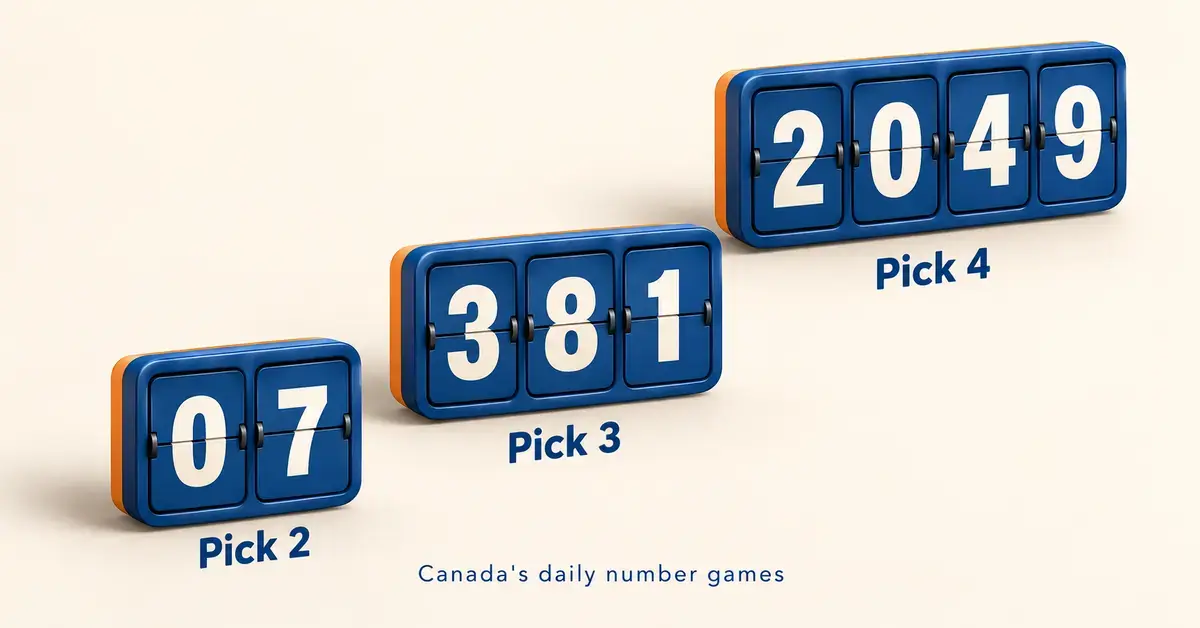
Pick 2, Pick 3 and Pick 4 are Canada’s daily “number” lottery games — fast draws where you choose a short string of digits and try to match the ones drawn, instead of selecting six or seven balls from a large pool. They cost as little as $1, are drawn up to twice a day, and pay fixed or shared prizes that are small next to a Lotto Max jackpot but land far more often. This guide explains how each game works, the difference between Straight and Box play, what a ticket costs, the real odds, and where you can play across the country.
Key Points
- Pick 2, Pick 3 and Pick 4 are daily number games: you choose digits (0–9) and match them, rather than picking balls from a large pool.
- In Ontario, OLG runs all three; each is drawn twice a day — Midday (about 2:00 p.m. ET) and Evening (about 10:30 p.m. ET).
- Straight Play means matching in exact order for the top prize; Box Play means matching in any order for a smaller prize with better odds.
- Pick 2 pays a flat $99; Pick 4 has fixed prizes up to $5,000; Pick 3’s top prize is a shared pari-mutuel pool.
- Availability is regional — WCLC offers Pick 3 in the Prairies, and Loto-Québec runs La Quotidienne 2, 3 and 4.
- The odds never change based on which digits you pick, and every play type has a negative expected value.
What are Pick 2, Pick 3 and Pick 4?
Pick 2, Pick 3 and Pick 4 are daily draw games built around single digits (0–9) rather than numbered balls. The name tells you how many digits you choose: two for Pick 2, three for Pick 3 and four for Pick 4. In Ontario all three are run by the Ontario Lottery and Gaming Corporation (OLG), and they sit alongside other quick daily games such as Daily Keno. Because each digit is drawn independently, a digit can repeat — a Pick 3 result of 5-5-2 or 7-7-7 is perfectly valid.
These games differ from the national draws in two important ways. First, the pools are tiny by comparison, so the odds of winning something are far better than a 6/49 or Lotto Max jackpot. Second, they are drawn twice a day, every day, giving two chances to play rather than two or three nights a week. They are regional games, so exactly which ones you can buy depends on your province.
How does each Pick game work?
Pick 2
Pick 2 costs $2 per play and asks you to choose two digits, giving a number from 00 to 99. Match both digits in exact order and you win the top prize of $99, at odds of 1 in 100. Match just the first digit and you win $2, at odds of about 1 in 11. Overall, roughly 1 in 10 plays wins some prize. It is the simplest and cheapest of the three games, with a flat, fixed payout rather than a growing jackpot.
Pick 3
Pick 3 lets you wager $1, $2, $5 or $10 per play and choose three digits, giving a number from 000 to 999. Unlike Pick 2 and Pick 4, Pick 3 is a pari-mutuel game, which means the prize money is a shared pool rather than a fixed amount: the pool is set at 50% of the value of tickets sold for that draw, and it is split among the winners. Matching all three digits in exact order (a Straight Play) wins the top share of that pool; matching in any order (a Box Play) wins a smaller share. Because the amount depends on sales and on how many people win, the exact dollar figure changes from draw to draw. The jackpot odds for a Straight Play are 1 in 1,000, and the overall chance of winning any prize is about 1 in 9.
Pick 4
Pick 4 costs $1 per play and asks for four digits, giving a number from 0000 to 9999. Unlike Pick 3, its prizes are fixed — you know exactly what each result pays before you buy. The top prize is $5,000 for matching all four digits in exact order. The table below shows every OLG Pick 4 prize tier and its odds:
| Play type | Prize | Odds of winning |
|---|---|---|
| Straight Play (exact order) | $5,000 | 1 in 10,000 |
| 4-Way Box Play | $1,250 | 1 in 2,500 |
| 6-Way Box Play | $800 | 1 in 1,667 |
| 12-Way Box Play | $400 | 1 in 833 |
| 24-Way Box Play | $200 | 1 in 417 |
Straight Play vs Box Play: what is the difference?
Straight Play and Box Play are the two main ways to play Pick 3 and Pick 4, and the choice is the single most important thing to understand before you buy.
Straight Play
A Straight Play wins only if your digits match the draw in the exact order they come out. If you play 1-2-3 on Pick 3, you win the top prize only for a result of 1-2-3 — not 3-2-1 or 2-1-3. Straight Play is the hardest to hit (1 in 1,000 for Pick 3, 1 in 10,000 for Pick 4) and therefore pays the most.
Box Play
A Box Play wins if your digits match in any order. Playing 1-2-3 as a Box would win on 1-2-3, 3-2-1, 2-3-1 and every other arrangement. Because more arrangements win, the odds improve but the prize is smaller. How much smaller depends on how many unique arrangements your digits have, which is where the “way” labels come from:
- 6-Way (Pick 3) or 24-Way (Pick 4): all digits are different (for example 1-2-3 or 1-2-3-4), so there are the most winning combinations and the smallest prize.
- 3-Way (Pick 3), 4-Way, 6-Way or 12-Way (Pick 4): some digits repeat (for example 1-1-2 or 1-1-2-2), so there are fewer combinations and a larger prize.
- Triples/quads (such as 7-7-7): there is only one arrangement, so these are played as a Straight only.
On OLG Pick 3, a Straight win pays three times the Box share when two digits are identical and six times the Box share when all three are unique — a direct reflection of how many fewer ways there are to hit a Straight.
When are the draws and how do you buy a ticket?
In Ontario, Pick 2, Pick 3 and Pick 4 are each drawn twice a day: a Midday draw at about 2:00 p.m. Eastern Time and an Evening draw at about 10:30 p.m. Eastern Time. Sales close a short time before each draw, so a ticket bought after the cut-off is entered in the next draw. You can buy at any lottery retailer using a selection slip, by asking for a Quick Pick (the terminal chooses your digits at random), or with slipless play by telling the clerk your numbers; OLG also sells the games through its website and app.
For an extra $1 you can add ENCORE, the optional add-on that runs on a separate seven-digit draw with its own $1,000,000 top prize — it is not part of the Pick result itself. After the draw, you can confirm a win using a retailer’s self-checker, the official app or the winning-numbers page; our guide on how to check your lottery numbers walks through each method.
How do the prizes and odds compare?
The three games trade prize size against how often they pay. Pick 2 wins most often but pays the least; Pick 4 pays the most but is the hardest to hit on a Straight Play. The table below sets the OLG versions side by side so you can see the trade-off at a glance.
Pick Games Compared
| Game | Digits you pick | Cost per play | Top prize | Jackpot odds | Draws |
|---|---|---|---|---|---|
| Pick 2 | 2 digits (00–99) | $2 | $99 (fixed) | 1 in 100 | Twice daily |
| Pick 3 | 3 digits (000–999) | $1, $2, $5 or $10 | Share of the prize pool (pari-mutuel) | 1 in 1,000 (Straight) | Twice daily |
| Pick 4 | 4 digits (0000–9999) | $1 | $5,000 (fixed) | 1 in 10,000 (Straight) | Twice daily |
Figures shown are for the OLG (Ontario) versions; other provinces may differ.
Two things are worth repeating. Pick 3’s top prize is a shared pool, so the figure moves with sales and the number of winners, while Pick 2 and Pick 4 pay fixed amounts you can count on in advance. And “better odds” here means a better chance of a small prize — like every lottery game, all three have a negative expected value, meaning the average ticket returns less than it costs.
Where can you play Pick games in Canada?
Daily number games are regional, run by the provincial lottery corporations rather than nationally, so availability depends on where you live. The three corporations that offer them are:
- OLG (Ontario): runs all three — Pick 2, Pick 3 and Pick 4 — plus Daily Keno.
- WCLC (Alberta, Saskatchewan, Manitoba and the territories): runs Pick 3, drawn daily in Western Canada.
- Loto-Québec (Quebec): runs the equivalent games as La Quotidienne 2, 3 and 4, with wagers from $0.50 to $10 and exact-order or any-order play.
If you are outside these regions, your provincial corporation may offer a different mix of daily games or none at all. To see who operates what, read our overviews of provincial and regional lotteries in Canada and who runs lotteries in Canada. Prize tables and draw times vary by corporation, so always confirm the current rules on your own provincial lottery’s official site.
Common mistakes to avoid
A few misunderstandings cost players money or missed prizes on these games:
- Thinking some digits are “due.” Each draw is independent and random; a digit that has not appeared for days is no more likely to come up next. There is no pattern to exploit — see our explainer on quick pick versus choosing your own numbers.
- Confusing Straight and Box. Buying a Straight Play and then matching your digits in the wrong order wins nothing. If order is hard to predict, a Box Play is what pays on any arrangement.
- Expecting a fixed Pick 3 prize. Pick 3 is pari-mutuel, so the amount is a share of the pool and is not known in advance; only Pick 2 and Pick 4 pay set amounts.
- Missing the sales cut-off. Buy too close to a draw and your ticket rolls to the next one. Check whether you are playing the Midday or Evening draw.
- Not checking both draws. With two draws a day, it is easy to check the wrong one; confirm the date and draw time on your ticket.
Who are these games for?
Pick 2, Pick 3 and Pick 4 suit players who prefer small stakes, frequent draws and a realistic chance of a modest win over the once-in-a-lifetime odds of a national jackpot. A $1 or $2 ticket, two draws a day and prizes measured in dollars or thousands rather than millions make them a low-cost form of entertainment. They are not an investment or an income strategy: over time the average return is negative, and no play type or digit choice changes that. If a large guaranteed-style prize appeals more, the national games work very differently.
Responsible play and disclaimer
This article is general information, not financial, legal or gambling advice. Lotteries are games of chance with a negative expected value, which means that on average players lose money over time; no system, pattern or choice of digits improves your odds. You must be of legal age to play (18 or 19 depending on the province). Prize amounts, odds and draw times are set by the official lottery corporations and can change — always confirm the current rules and results with your provincial corporation before playing or claiming.
If gambling is affecting you or someone you know, free, confidential help is available. In Ontario, ConnexOntario operates a 24/7 line at 1-866-531-2600. For warning signs, self-exclusion options and provincial support programs, see our responsible gambling guide.
Sources
Frequently Asked Questions (FAQ)
What is the difference between Pick 3 and Pick 4?
Pick 3 uses three digits (000–999) and is a pari-mutuel game, so its top prize is a shared pool worth 50% of that draw’s sales. Pick 4 uses four digits (0000–9999) and pays fixed amounts, topping out at $5,000 for an exact-order Straight Play.
Does Box Play have better odds than Straight Play?
Yes. A Box Play wins if your digits match in any order, so there are more winning combinations and better odds — but each Box prize is smaller than the Straight Play prize, which requires an exact-order match.
How much does a Pick ticket cost?
In Ontario, Pick 2 costs $2 per play, Pick 4 costs $1 per play, and Pick 3 lets you wager $1, $2, $5 or $10 per play. An optional ENCORE add-on is $1 more. Costs can differ in other provinces.
Can I play Pick 2, Pick 3 and Pick 4 everywhere in Canada?
No. They are regional games. OLG offers all three in Ontario, WCLC offers Pick 3 in the Prairies and territories, and Loto-Québec runs them as La Quotidienne 2, 3 and 4 in Quebec. Availability elsewhere varies.
Are Pick game winnings taxed in Canada?
Lottery winnings in Canada are treated as a tax-free windfall and are not reported as income, so a Pick prize is paid in full. Any income you later earn from investing the money, however, can be taxable.
