

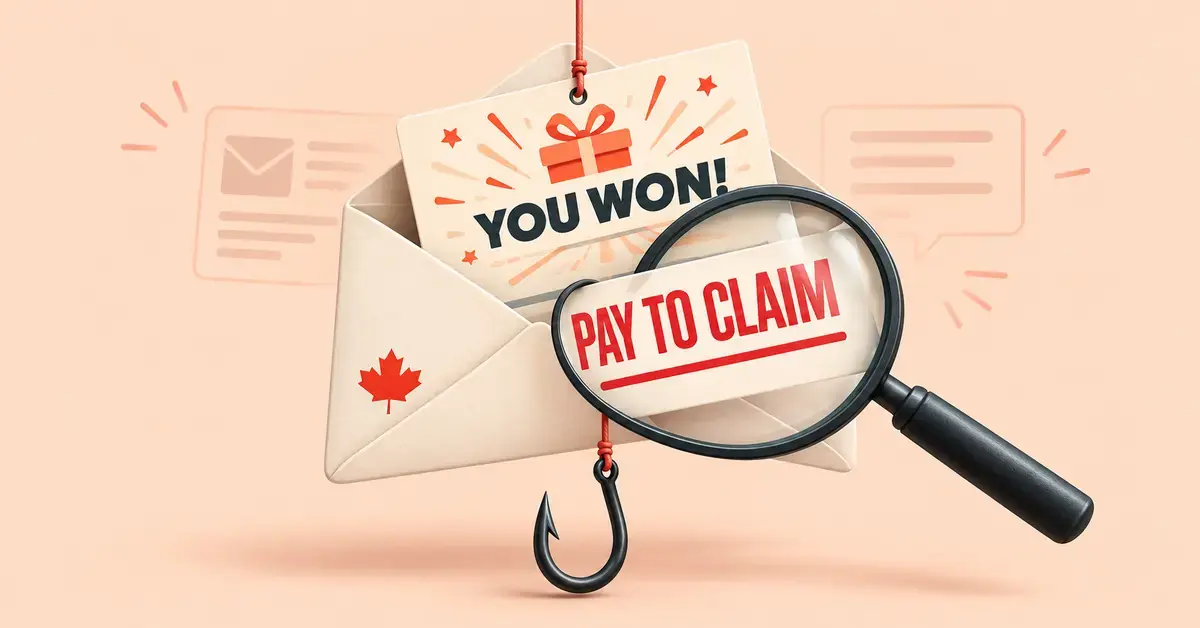
Lottery scams are among the most reported frauds in Canada, and they all share one goal: to make you pay money or hand over personal details for a prize that does not exist. Fraudsters phone, email, text, message on social media and still send letters, telling you that you have won a lottery or sweepstake and must act quickly. This guide explains the common lottery scams seen in Canada, the warning signs that give them away, how a real Canadian win actually works, and exactly where to report fraud.
Key Points
- No upfront payment, ever. A legitimate Canadian lottery never charges a fee or tax to release winnings.
- No ticket, no win. You cannot win a draw you did not buy a ticket for — including “foreign” lotteries.
- Corporations don’t cold-call winners. OLG, WCLC, BCLC, Atlantic Lottery and Loto-Québec do not phone or email you out of the blue.
- Watch the payment method. Demands for wire transfer, gift cards or cryptocurrency are a hallmark of fraud.
- Report it. Contact the Canadian Anti-Fraud Centre at 1-888-495-8501, plus police and your bank if money was lost.
What is a lottery scam?
A lottery scam is a fraud in which someone is told they have won a lottery, draw or sweepstake and is then pressured to pay a fee or share personal information to “release” the winnings. The prize never arrives. The Canadian Anti-Fraud Centre (CAFC) — the national agency that collects fraud reports — classes these under “prize” scams and notes a simple truth that sits behind all of them: no winnings are ever received.
The core trick is the advance fee. You are promised a large sum but told you must first pay a smaller amount — described as taxes, legal fees, customs, insurance or a processing charge — before the money can be sent. Because the promised prize dwarfs the fee, the request can feel reasonable. It is not. In Canada there are no fees or taxes to pay to collect a legitimate lottery prize, so any upfront payment request is the clearest sign of a scam.
The most common lottery scams in Canada
Lottery fraud in Canada shows up in a handful of recurring forms. They use different stories, but the mechanics and the red flags overlap. Here are the ones reported most often.
The advance-fee prize scam
This is the classic lottery scam. You receive an unsolicited message saying you have won a major prize and must pay a fee — for “taxes,” “legal costs” or “release” — before the winnings are sent. Payment is usually requested by wire transfer, prepaid gift cards or cryptocurrency, all of which are fast and very hard to trace or reverse. Once you pay, the scammer either disappears or invents a new fee to extract more money.
The foreign or international lottery scam
Here you are told you have won an overseas lottery — often a large, official-sounding draw in another country. The catch is that you can only win a lottery you actually entered by buying a ticket. If you never travelled to that country and bought a ticket there, you did not win anything. Selling or promoting most foreign lottery tickets by mail or across borders is also restricted, so an “international winnings” notice is a strong signal of fraud.
The fake-cheque and overpayment scam
In this version the scammer sends a real-looking cheque for part of your “winnings” and asks you to deposit it, then wire back a portion to cover fees or taxes. The cheque is counterfeit. It can take days for your bank to discover it has bounced — by which time your own real money has already been sent to the fraudster and cannot be recovered. A legitimate prize is never paid by sending you a cheque and asking you to return part of it.
Impersonation of official lottery corporations
Fraudsters sometimes pose as a real Canadian lottery body — OLG in Ontario, the Western Canada Lottery Corporation, BCLC, Atlantic Lottery or Loto-Québec — to sound trustworthy. The call or email might quote a specific jackpot figure and a “claim reference.” But Canada’s lottery corporations do not phone or email people out of the blue to tell them they have won, and they never ask for a payment to release a prize. If a caller claims to be from a provincial corporation and asks for money or banking details, hang up.
Social-media and messaging “giveaway” scams
On Facebook, Instagram, WhatsApp and similar platforms, scammers create accounts that impersonate real jackpot winners or official lottery pages and announce that they are “giving away” money to lucky followers. To receive your share, you are asked to pay a small “processing” or “delivery” fee or to hand over account details. Genuine winners and lottery corporations do not direct-message strangers offering free cash, and no real giveaway requires you to pay first.
Sweepstakes and “prize patrol” phone calls
The CAFC has long tracked calls in which someone claims to represent a well-known brand such as Reader’s Digest or Publishers Clearing House and says you have won a car or a cash prize. The pitch ends the same way: pay a fee for taxes, legal costs or delivery first. Seniors are targeted heavily with this approach. Legitimate sweepstakes do not charge winners to claim what they have won.
Second-chance and fake-ticket schemes
Some scams happen closer to home. A stranger may claim to hold a “winning” ticket they cannot cash themselves and ask you to pay them for it, or to split the prize if you claim it. Others push fake “second-chance” draws or counterfeit tickets. The only reliable way to know whether a ticket is a winner is to check it through an official retailer, terminal or provincial app — never on someone else’s say-so.
Common Lottery Scams at a Glance
| Scam type | How it reaches you | The tell | The reality |
|---|---|---|---|
| Advance-fee prize | Email, letter, call, text | Pay a “fee” or “tax” to release winnings | No Canadian prize requires an upfront payment |
| Foreign / international lottery | Email, mail | You “won” a draw abroad you never entered | You can’t win a lottery you didn’t buy a ticket for |
| Fake cheque / overpayment | Mail, courier | A real-looking cheque arrives; wire back the “excess” | The cheque bounces days later and you owe the bank |
| Official-body impersonation | Phone, email | Caller claims to be OLG, WCLC or Loto-Québec | Corporations don’t cold-call or email winners |
| Social-media giveaway | Facebook, Instagram, WhatsApp | A “winner” or lottery page offers free cash for a fee | Real winners and corporations never DM strangers |
| Sweepstakes / prize-patrol call | Phone, mail | “Reader’s Digest / Publishers Clearing House” car or cash | Legitimate sweepstakes never charge you to claim |
| Second-chance / fake ticket | In person, online | Someone wants you to pay for or cash a “winning” ticket | Verify every ticket only at an official retailer or app |
How to spot a lottery scam: the red flags
The quickest way to recognise a lottery scam is to watch for a short list of warning signs. One alone is reason for caution; two or more almost always means fraud.
- You are told you won a draw you never entered. You cannot win a lottery you did not buy a ticket for.
- You are asked to pay a fee or tax first. No legitimate Canadian lottery charges anything to release a prize.
- Payment is demanded by wire transfer, gift cards or cryptocurrency. These untraceable methods are a hallmark of fraud.
- You are pressured to act fast. “Limited time” urgency is designed to stop you checking.
- The message comes from a free email account such as Gmail, Yahoo or Hotmail, or a personal phone number, rather than an official organisation.
- You are asked for your SIN, banking details, PIN or passwords. A prize claim never needs these over an unsolicited call or email.
- You are told to keep the “win” confidential until you have paid — a tactic to keep you from asking others for a second opinion.
How a real lottery win works in Canada
Knowing how legitimate prizes are paid makes the scams easy to see through. Here is the reality that every scam contradicts.
You must buy a ticket to win
Canadian lottery prizes only go to people holding a valid ticket bought through an authorised retailer or an official provincial platform. Draws are not won by having your email address or phone number “selected.” If you did not buy a ticket, there is no prize. You can confirm any result yourself — see our guide on how to check your lottery numbers in Canada.
There are no fees or taxes to claim a prize
Lottery winnings in Canada are treated as a tax-free windfall, so you never pay tax to the government to collect them, and the lottery corporation never charges a release fee. Our explainer on whether lottery winnings are taxed in Canada covers this in detail. Because of this, any demand to pay “tax” or a “fee” before you can receive winnings is, by itself, proof of a scam.
Official corporations don’t cold-call winners
Prizes are claimed by the winner coming forward with the ticket, not by the corporation tracking you down. Depending on the amount, you validate a win at a retailer, online or at a regional prize office — the steps are set out in our guide on how to claim a lottery prize in Canada. The five Crown corporations that run the games — explained in our overview of who runs lotteries in Canada — do not phone or email people unprompted to announce a win. Note too that major Canadian winners generally cannot stay anonymous, which is why scammers sometimes misuse real winners’ names and photos to look convincing.
Common mistakes that let scams succeed
Even people who know scams exist can be caught out. These are the mistakes that most often turn a suspicious message into a loss.
- Replying “just to check.” Any response confirms your contact is live and invites more pressure. Do not engage — delete or hang up.
- Using the contact details in the message. Phone numbers and links in a scam lead back to the scammer. Verify only through a lottery corporation’s official website or published number that you look up yourself.
- Trusting a cheque because it “cleared.” A deposit showing in your account is not the same as a cheque clearing; counterfeit cheques can bounce days later, leaving you liable.
- Paying a “small” fee. The fee is the scam. Paying once marks you as a target and usually triggers further demands.
- Sharing personal or banking information. Your SIN, card number, PIN or online-banking login should never be given to claim a prize.
- Feeling too embarrassed to report. Scammers rely on silence. Reporting helps investigators and warns others.
What to do if you are targeted or scammed
If you receive a suspicious lottery message, do not reply, do not pay, and do not share any details. Then take these steps.
- Report it to the Canadian Anti-Fraud Centre (CAFC) at 1-888-495-8501 or through its official website, whether or not you lost money. Your report helps track and disrupt these frauds.
- Contact your local police or the RCMP if you have lost money or feel threatened.
- Tell your bank or financial institution right away if you sent a payment or shared banking information, so they can try to stop or trace it and protect your accounts.
- Keep the evidence — emails, letters, texts, phone numbers and any receipts — to support the investigation.
- Verify independently if you are ever unsure about a real win, by contacting your provincial lottery corporation directly using the details on its official site.
Disclaimer
This article is informational only and is not legal, financial or security advice. LottoGuide.ca is an independent guide and is not affiliated with any lottery corporation or law-enforcement agency, and we cannot verify tickets, pay prizes or investigate fraud. If you believe you have been targeted by a scam, report it to the Canadian Anti-Fraud Centre at 1-888-495-8501 and to your local police or the RCMP. If gambling is causing harm for you or someone you know, confidential help is available through your provincial responsible-gambling service — see our page on responsible gambling in Canada.
Sources
- Canadian Anti-Fraud Centre — Prize scams
- Alberta Gaming, Liquor and Cannabis (AGLC) — Lottery prize scams
- Financial and Consumer Services Commission of New Brunswick — Prize or sweepstakes scam
- CIBC — What’s a lottery and prize scam?
- Lethbridge Police Service — Lottery scams: if you didn’t enter, you didn’t win
- Heart & Stroke Lottery — Consumer protection
Frequently Asked Questions (FAQ)
How do I know if a lottery win is real or a scam?
A real win always starts with a ticket you bought yourself, and it never requires an upfront payment. If you are told you won a draw you did not enter, or asked to pay a fee or tax before receiving winnings, it is a scam. Verify any result through an official retailer, terminal or provincial app rather than through the message.
Do I have to pay tax or a fee to claim a lottery prize in Canada?
No. Lottery winnings in Canada are a tax-free windfall, and the lottery corporation does not charge a fee to release a prize. Any request to pay taxes, legal costs or a processing fee before you can collect is a sure sign of fraud.
Can I win a foreign or international lottery I never entered?
No. You can only win a lottery you entered by buying a valid ticket. A message saying you have won an overseas draw you never played is a scam, especially if it asks for a fee to release the money.
Will OLG or another lottery corporation call to tell me I won?
No. Canada’s lottery corporations do not phone or email people out of the blue to announce a win, and they never ask for payment to claim one. A caller claiming to be from a provincial corporation and requesting money or banking details is impersonating it.
Where do I report a lottery scam in Canada?
Report it to the Canadian Anti-Fraud Centre at 1-888-495-8501 or through its official website, whether or not you lost money. If you have lost money or feel threatened, also contact your local police or the RCMP, and tell your bank immediately if you shared payment or banking information.
