

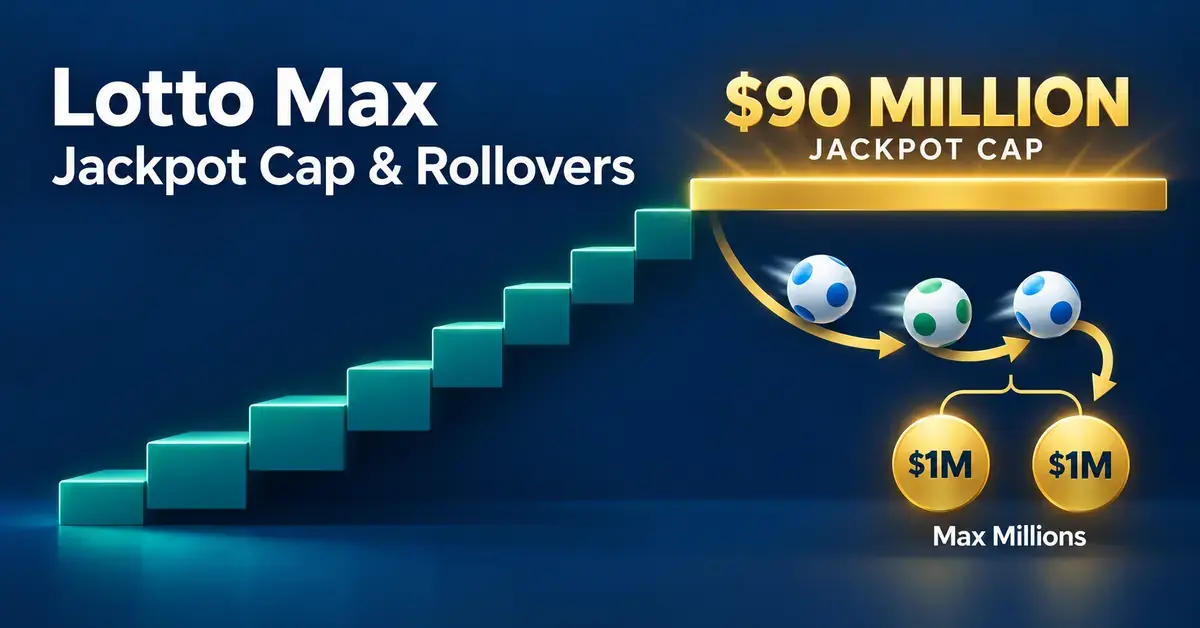
Lotto Max has a hard ceiling on its headline prize: the main jackpot can grow to a maximum of $90 million and no higher. That ceiling, known as the jackpot cap, is the reason you often see Lotto Max advertise a $90 million jackpot for several draws in a row instead of climbing endlessly like some lotteries abroad. This guide explains how the jackpot builds, what the $90 million cap is, what happens to the money once the cap is reached, and how rollovers, Max Millions and the newer MaxPlus prizes fit together.
Key Points
- Jackpot cap: the Lotto Max main jackpot maxes out at $90 million (raised from $80 million on April 14, 2026).
- Starting point: the jackpot begins at a guaranteed $10 million and grows when no one wins.
- Growth: sales-dependent, often around $5 million per draw below the cap — not a fixed amount.
- At the cap: overflow money becomes $1 million Max Millions prizes rather than a bigger headline jackpot.
- Max Millions start once the jackpot reaches $50 million; MaxPlus pays $100,000 for every $1 million in the jackpot.
- Draws: Tuesday and Friday; a win resets the jackpot to $10 million.
What is the Lotto Max jackpot cap?
The Lotto Max jackpot cap is the maximum value the advertised main jackpot can reach — currently $90 million. Once the headline prize is estimated at $90 million, it stops growing, even if nobody wins and the prize pool keeps collecting money. The cap was raised from $80 million to $90 million starting with the draw on April 14, 2026, part of a broader overhaul of the game.
A cap matters because a lottery’s prize pool is funded by ticket sales, and sales tend to surge when the top prize is huge. Without a ceiling, a single jackpot could balloon to levels the operator considers excessive. Capping the main prize lets the game redirect the extra money into additional prizes instead — which is where Max Millions and MaxPlus come in, covered below.
How does the Lotto Max jackpot grow?
The Lotto Max jackpot starts at a guaranteed $10 million and builds from draw to draw whenever nobody wins the top prize. Lotto Max is drawn twice a week, on Tuesday and Friday, so an unwon jackpot can climb quickly over a run of draws.
The size of each increase is not a fixed figure — it depends on how many tickets are sold for that draw. In practice the advertised jackpot often rises by roughly $5 million from one draw to the next while it is below the cap, but the exact jump reflects sales, not a set formula. Because interest (and therefore sales) tends to grow as the prize gets bigger, the increases can accelerate on the way up.
When a ticket matches all seven main numbers, the jackpot is won and resets to $10 million for the following draw, and the climb begins again.
What happens when the jackpot hits the $90 million cap?
Once the advertised jackpot reaches the $90 million cap, the main prize is frozen at $90 million and any additional money that would have pushed it higher is redirected into $1 million Max Millions prizes. In other words, the overflow does not disappear and it does not inflate the headline number — it is split into separate seven-figure draws that sit alongside the main jackpot.
This is why you can see a Lotto Max draw advertised as “$90 million plus 20 Max Millions”: the $90 million is the capped main prize, and the 20 Max Millions are the overflow, each worth $1 million. The longer the main jackpot goes unwon at the cap, the more Max Millions prizes tend to be offered.
What are Max Millions?
Max Millions are extra $1 million prizes that Lotto Max offers on top of the main jackpot. They begin to appear once the main jackpot reaches $50 million, and they are the vehicle used to hand out the overflow once the jackpot is capped at $90 million.
Each Max Millions prize has its own randomly generated set of seven numbers, and you win a Max Millions prize only by matching all seven numbers on one line — there are no smaller consolation prizes within a Max Millions draw. If a Max Millions prize is not won, it is carried over to the next draw, and more are typically added while a jackpot of at least $50 million keeps rolling over. When the main jackpot is finally won, any unclaimed Max Millions money is added back on top of the $10 million reset for the next draw.
What is MaxPlus?
MaxPlus is a prize tier introduced with the April 14, 2026 overhaul that pays $100,000 for every $1 million in the main jackpot. The number of MaxPlus prizes in a draw equals the jackpot expressed in millions: a $10 million jackpot offers 10 MaxPlus prizes, a $50 million jackpot offers 50, and a capped $90 million jackpot offers 90.
Like Max Millions, MaxPlus prizes are won by matching all seven numbers in a dedicated draw, with no secondary prizes. MaxPlus means the total money available on a big Lotto Max draw is larger than the headline figure alone suggests, because the $100,000 prizes scale directly with the size of the jackpot.
Why do Lotto Max jackpots plateau?
Lotto Max jackpots plateau because of the cap: the advertised main prize simply cannot climb past $90 million. So when you notice the top prize stuck at $90 million for several draws in a row, the game has not stalled — the main jackpot has maxed out, and all the additional money is flowing into Max Millions and MaxPlus prizes instead of into a bigger headline number.
This is a deliberate design choice shared by Canada’s national games. It keeps the top prize within a defined range while still rewarding the surge in ticket sales that big jackpots create, by multiplying the number of large secondary prizes rather than the single main one.
A short history of the Lotto Max maximum jackpot
The Lotto Max maximum jackpot has been raised several times since the game launched in 2009, each increase reflecting growth in the game and in ticket sales. The $90 million cap set in April 2026 is the highest in Canadian lottery history to date.
Jackpot Cap History
| Maximum jackpot | Effective from | Notes |
|---|---|---|
| $50 million | September 2009 (launch) | Original cap when Lotto Max began |
| $60 million | July 17, 2015 | First increase |
| $70 million | May 14, 2019 | Number pool grew to 1–50; second weekly draw added |
| $80 million | September 10, 2024 | Fourth cap level |
| $90 million | April 14, 2026 | Current cap; pool grew to 1–52, MaxPlus prizes added, price rose to $6 |
How Lotto Max rollovers work
A rollover happens whenever a draw produces no top-prize winner, carrying the main jackpot forward to the next draw. Below the cap, each rollover increases the advertised jackpot. At the cap, rollovers no longer raise the main prize — instead they add to the pool of Max Millions and MaxPlus prizes.
A few practical points about rollovers:
- Twice-weekly draws. Because Lotto Max draws on Tuesday and Friday, an unwon jackpot rolls over quickly, which is how it can reach the cap within a few weeks of a reset.
- The reset. When the jackpot is won, it drops back to the guaranteed $10 million for the next draw, plus any unclaimed Max Millions money.
- Overflow is kept, not lost. Money collected while the jackpot is capped is paid out as $1 million Max Millions prizes, so a long run at $90 million means more seven-figure prizes in play.
Lotto Max at a glance: price, numbers and odds
The April 2026 overhaul changed more than the cap. Understanding the current format helps put the jackpot structure in context:
- Price: $6 per play, up from $5. One play gives you four lines of seven numbers.
- Number pool: seven numbers are drawn from 1 to 52 (previously 1 to 50).
- Draws: Tuesday and Friday each week.
- Jackpot odds: about 1 in 33,446,140 per $6 play.
- Any prize: roughly 1 in 5.8 per $6 play, an improvement from the previous odds of about 1 in 7.
For a broader overview of how Canada’s national games compare, see the Canadian Lottery Guide, which covers Lotto 6/49, Lotto Max and Daily Grand side by side.
Common mistakes and misconceptions
Several misunderstandings come up repeatedly around the Lotto Max jackpot cap and rollovers:
- Thinking a capped jackpot means the draw is “smaller.” A $90 million draw with dozens of Max Millions and MaxPlus prizes actually puts more total money in play than many lower draws — the headline figure is only part of the picture.
- Assuming the jackpot grows by a fixed amount each draw. Growth depends on ticket sales, so the increase varies from one draw to the next rather than following a set $5 million step.
- Believing Max Millions have better odds than the jackpot. Each Max Millions and MaxPlus line requires matching all seven numbers, so the per-line odds are essentially the same as the main jackpot — there are simply more lines to win.
- Expecting the overflow money to be lost. Money collected once the cap is reached is redirected into prizes, not kept back by the operator.
- Confusing older figures with the current game. Many websites still list a $5 ticket, a 1–50 pool or an $80 million cap. Since April 14, 2026 the correct figures are $6, 1–52 and a $90 million cap.
Who should understand the jackpot cap?
Anyone following a Lotto Max jackpot run benefits from understanding the cap, because it explains why the advertised prize freezes and where the extra prize money goes. If you are comparing a $90 million draw against a smaller one, the number of Max Millions and MaxPlus prizes — not just the headline jackpot — tells you how much is really being given away.
A note on responsible play
This article is informational and unofficial; it is not gambling advice and does not encourage play. Lotteries are games of chance, the odds of winning the Lotto Max jackpot are extremely long, and no strategy, number pattern or ticket quantity changes them. You must be of legal age to play — 18 or 19 depending on your province. If gambling is affecting you or someone you know, free, confidential help is available in Canada through the Responsible Gambling Council. Always check the official provincial lottery corporation for the current rules and game conditions.
Sources
- OLG — About Lotto Max (official game information)
- Daily Hive — Major changes coming to Lotto Max in 2026
- To Do Canada — Lotto Max overhaul begins April 14 with $90 million cap and new $100K prizes
- Public Gaming — Canada Lotto Max game changes, including bigger $90 million jackpots
- Casino.org — New $90 Million Jackpot for Canada’s Lotto Max
- CTV News — Historic jackpot raises questions about the Lotto Max prize cap
Vanliga frågor (FAQ)
What is the maximum Lotto Max jackpot?
The maximum Lotto Max jackpot is $90 million. The cap was raised from $80 million to $90 million starting with the draw on April 14, 2026, and it is the largest main jackpot offered by any Canadian lottery.
Why does the Lotto Max jackpot stop at $90 million?
Because of the jackpot cap. Once the advertised main prize reaches $90 million it is frozen, and any additional money is paid out as $1 million Max Millions prizes instead of increasing the headline jackpot.
How much does the Lotto Max jackpot grow each draw?
There is no fixed amount. The jackpot starts at $10 million and grows based on ticket sales each time there is no winner, often by around $5 million per draw while it is below the cap, with the exact increase depending on how many tickets are sold.
What happens to Lotto Max money once the jackpot is capped?
It is redirected into additional prizes. The overflow above the cap is split into separate $1 million Max Millions prizes, and MaxPlus prizes of $100,000 each are offered for every $1 million in the main jackpot.
What is a Lotto Max rollover?
A rollover is when a draw has no top-prize winner and the jackpot carries forward to the next draw. Below the cap this raises the advertised jackpot; at the cap it adds more Max Millions and MaxPlus prizes instead.
