

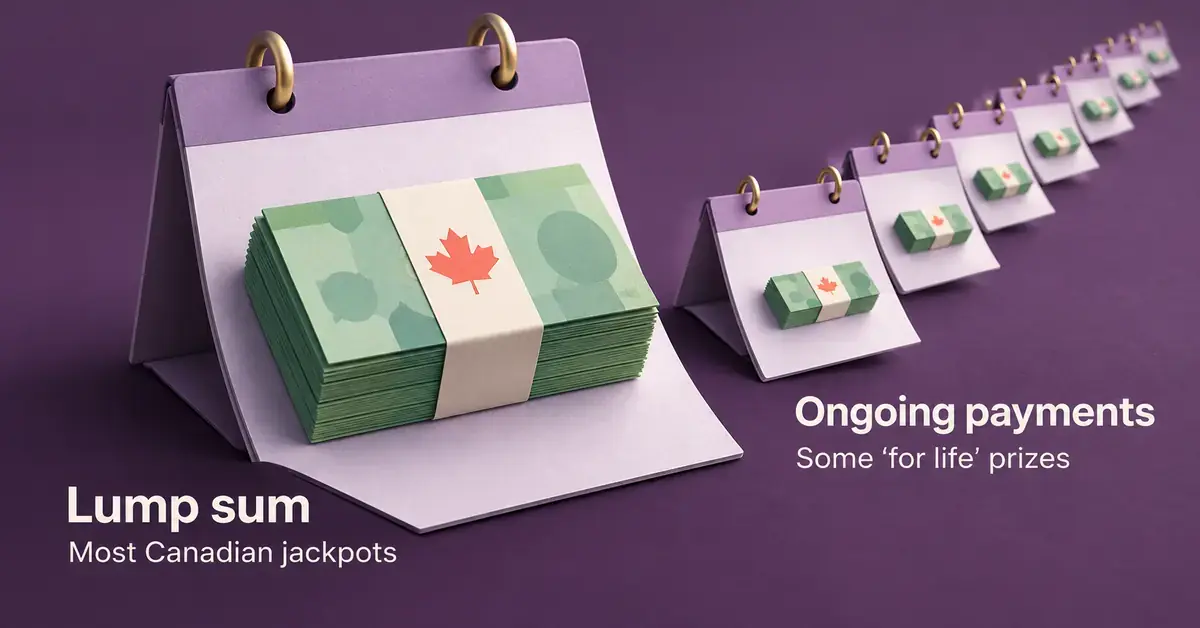
If you win a big Canadian lottery, how do you actually get the money — all at once, or spread out over many years? The short answer is that almost every Canadian lottery prize is paid as a single, one-time cash payment (a lump sum), and that payment is tax-free. The familiar American choice between a smaller “cash option” and a decades-long annuity (a series of fixed payments) simply does not exist for the main Canadian draw games. The one real exception is a small group of “for life” prizes, where you can choose between an ongoing payment and a lump sum. This guide explains which games pay which way, how the choice works where it exists, and why Canada differs so sharply from the United States.
Key Points
- Canada’s main draw jackpots — Lotto 6/49 and Lotto Max — are paid as a single lump sum, with no annuity option.
- The advertised jackpot is the cash amount; there is no US-style “cash value” discount.
- Only “for life” games offer an annuity choice: Daily Grand, Cash for Life instant tickets and Loto-Québec’s Gagnant à Vie.
- Daily Grand’s top prize is $1,000 a day for life or a $7,000,000 lump sum; second prize is $25,000 a year for life or $500,000.
- All Canadian lottery winnings are tax-free — nothing is withheld from either option.
- Where the choice exists, it is made once at claim time and is permanent.
Do Canadian lotteries pay a lump sum or an annuity?
For the national draw games, Canadian lotteries pay a lump sum — the full advertised jackpot in one payment, with no annuity alternative. When someone wins the Lotto 6/49 or Lotto Max jackpot, they receive the entire headline amount as a single cheque or transfer, and because lottery winnings are treated as a tax-free windfall in Canada, there is no tax taken off the top.
This is the opposite of how large lotteries work in the United States, where the advertised jackpot is really the annuity value and winners who want their money now must accept a much smaller “cash value.” In Canada, the number on the sign is the number you get. The only place an annuity enters the picture is a handful of “for life” games — and even there, a lump-sum alternative is always offered.
Which Canadian prizes are paid as a lump sum?
The overwhelming majority of Canadian lottery prizes are lump sums. That includes every prize tier on the three national draw games and virtually all instant and regional prizes:
- Lotto 6/49 — both the fixed $5 million Classic Draw jackpot and the growing Gold Ball Draw jackpot are paid as one cash payment.
- Lotto Max — the main jackpot (which grows up to its cap) and every separate Max Millions prize are single payments.
- Daily Grand’s cash alternative — if you take the cash instead of the “for life” payments (see below), that cash is a lump sum.
- Regional and provincial draws such as Ontario 49, Western 6/49, BC/49 and Québec Max — all paid in full, at once.
- Scratch and instant tickets — nearly all pay a one-time amount; the rare “for life” instant games are the exception noted below.
In other words, unless the game’s name literally promises money “for life” or “per year,” you are getting a lump sum. For a fuller picture of how the national games are structured, see our overview of how Canadian lotteries work.
Which Canadian lotteries offer an annuity (“for life”) option?
Only the “for life” games give you an annuity-style choice, and in each case you can take a lump sum instead. These are the games where the lump-sum-versus-annuity decision is real in Canada.
Daily Grand
Daily Grand is the national game built entirely around this choice. Launched in October 2016, it costs $3 per play (five main numbers from 1 to 49 plus a Grand Number from 1 to 7). Its top prize is $1,000 a day for life or a $7,000,000 lump sum; its second prize is $25,000 a year for life or a $500,000 lump sum. The “for life” payments carry a 20-year guaranteed minimum, so if a winner dies before 20 years have passed, the remaining payments go to a named beneficiary. We cover this decision in detail in our guide to the Daily Grand top prize and lump sum, and the full game in the Daily Grand rules and odds overview.
Cash for Life instant games
Several provinces sell “Cash for Life” style scratch tickets whose top prize is a weekly payment — commonly $1,000 a week for life — with a one-time lump sum offered as an alternative. The exact lump-sum figure is set per game and changes between editions (recent Ontario versions have offered roughly $675,000 in place of $1,000 a week for life), so always read the back of the specific ticket rather than assuming a fixed amount.
Loto-Québec’s Gagnant à Vie
In Quebec, Loto-Québec runs Gagnant à Vie (“Winner for Life”), whose top prize is $1,000 a week for life or a $1,000,000 lump sum. It works on the same principle as Daily Grand and the Cash for Life instants: an ongoing payment you can convert to a single cash amount if you prefer.
Comparison
| Game / prize | Payout type | “For life” / annuity option | Lump-sum option |
|---|---|---|---|
| Lotto 6/49 (Classic & Gold Ball jackpots) | Lump sum only | None | Full jackpot, one payment |
| Lotto Max (jackpot & Max Millions) | Lump sum only | None | Full amount, one payment |
| Daily Grand — top prize | Winner’s choice | $1,000 a day for life (20-year minimum) | $7,000,000 |
| Daily Grand — second prize | Winner’s choice | $25,000 a year for life | $500,000 |
| Cash for Life instant tickets | Winner’s choice | Typically $1,000 a week for life | One-time amount, varies by game |
| Gagnant à Vie (Loto-Québec) | Winner’s choice | $1,000 a week for life | $1,000,000 |
How does the lump-sum-versus-annuity choice actually work?
Where the choice exists, you make it once, at the time you claim — not later. When you come forward to validate a “for life” winning ticket, the lottery corporation asks whether you want the ongoing payments or the lump sum, and that decision is final. There is no option to start with payments and “cash out” the rest a few years later.
Two things are worth understanding before you decide. First, the lump sum offered by “for life” games is a fixed, pre-set figure — for example, $7,000,000 for Daily Grand’s top prize — not a running total of what the payments would eventually add up to. Second, because Canadian winnings are tax-free, neither the payments nor the lump sum is reduced by income tax, which removes one of the biggest complications American winners face.
How is this different from the United States?
In the US, the advertised jackpot is the annuity value, and winners choose between that annuity and a much smaller cash lump sum. Games such as Powerball and Mega Millions pay their annuity in 30 graduated instalments over 29 years, with each payment rising about 5% a year. A winner who wants the money immediately instead receives the “cash value,” which is typically only around half of the headline jackpot — and then US federal and state taxes are applied on top.
Canada differs on all three points: the headline amount is the cash amount, the main games have no annuity at all, and the winnings are not taxed. That is why a “$70 million” Canadian jackpot really is about $70 million in the winner’s account, while a “$700 million” US jackpot can shrink to a few hundred million after the cash discount and before taxes even begin. Historically, Canada did once run a long-annuity game — Millionaire Life (2007–2011), which offered $1 million a year for 25 years or a $17 million lump sum — but it was retired and replaced by Daily Grand.
Are Canadian lottery payouts taxed?
No — lottery winnings in Canada are a tax-free windfall and are not reported as income, whether you take a lump sum or the “for life” payments. This applies to all the national and provincial games. What can be taxed is the income your winnings later earn: interest, dividends or capital gains on money you invest, and in some cases gifts or US-sourced prizes. For the full picture, see our explainer on whether lottery winnings are taxed in Canada.
Lump sum versus annuity: the trade-offs
For the “for life” games, there is no universally “right” answer — it depends on your age, discipline, plans and what return you could earn on the money. The factual trade-offs look like this:
Reasons winners choose the lump sum
- You control and can invest the whole amount immediately.
- You are not relying on the payments continuing for decades to come out ahead.
- It is simpler to divide, gift or use for a large one-time purchase.
Reasons winners choose the “for life” payments
- A guaranteed income stream that cannot be spent all at once.
- It can total far more than the lump sum if you live a long time.
- Built-in protection against overspending or poor investment decisions.
Because this is a genuine financial decision, the lottery corporations and consumer agencies consistently suggest getting independent, professional advice before you claim. Our checklist on what to do if you win the lottery in Canada walks through the steps.
Common mistakes and misconceptions
Several myths lead people to the wrong expectations about how they will be paid:
- Assuming Canadian jackpots work like Powerball. They do not. There is no annuity option and no cash discount on Lotto 6/49 or Lotto Max — you get the full advertised amount.
- Thinking tax will be deducted. No tax is withheld from a Canadian lottery prize; the amount you win is the amount you receive.
- Believing you can change your mind. On “for life” games, the lump-sum-or-payments choice is made once, at claim time, and is permanent.
- Treating the lump sum as “less money.” The “for life” lump sum is a defined figure, not a cut-down version of a bigger prize — the two options are simply different ways to receive the same win.
- Ignoring the beneficiary rule. Daily Grand’s “for life” payments have a 20-year minimum that passes to a beneficiary, which matters if you are weighing the annuity for estate reasons.
Responsible gambling
Lotteries are games of chance with a negative expected value: over time, players pay in more than they win back. Choosing a lump sum or an annuity does not change your odds of winning and is not financial advice — before claiming any large or “for life” prize, consider independent professional guidance. You must be of legal lottery age in your province (18 or 19). If gambling is causing harm, free, confidential help is available 24/7 in Ontario through ConnexOntario at 1-866-531-2600 (or text CONNEX to 247247), and through your provincial responsible-gambling program elsewhere. See our responsible gambling in Canada resource for more.
Sources
- Daily Grand — prize structure and annuity terms
- OLG — Daily Grand game page
- ILC news release — Daily Grand top and second prize options
- Loto-Québec — lottery games and prize options
- Millionaire Life — former annuity game ($1M/year for 25 years or $17M)
- Powerball — annuity vs cash option (US comparison)
- Canada Revenue Agency — windfall / tax treatment of winnings
Vanliga frågor (FAQ)
Do Lotto 6/49 and Lotto Max pay a lump sum or an annuity?
Both pay a lump sum. The entire advertised jackpot — and every smaller prize tier — is paid as a single, tax-free cash payment. Neither game offers an annuity option.
Which Canadian lottery lets you choose a “for life” payment?
Daily Grand is the main one: $1,000 a day for life or a $7,000,000 lump sum for the top prize. Loto-Québec’s Gagnant à Vie and various Cash for Life instant tickets also offer weekly-for-life payments with a lump-sum alternative.
Is the Daily Grand lump sum smaller than the “for life” prize?
They are two different ways to take the same win, not a bigger and smaller version. The top-prize lump sum is a fixed $7,000,000, while $1,000 a day for life could total more or less depending on how long the winner lives.
Are lottery winnings taxed in Canada?
No. Lottery winnings are a tax-free windfall and are not reported as income, whether taken as a lump sum or as “for life” payments. Only the income you later earn on invested winnings can be taxable.
Can I switch from payments to a lump sum after I win?
No. On “for life” games you choose between the ongoing payments and the lump sum once, at the time you claim, and that decision is final. There is no later cash-out of remaining payments.
