

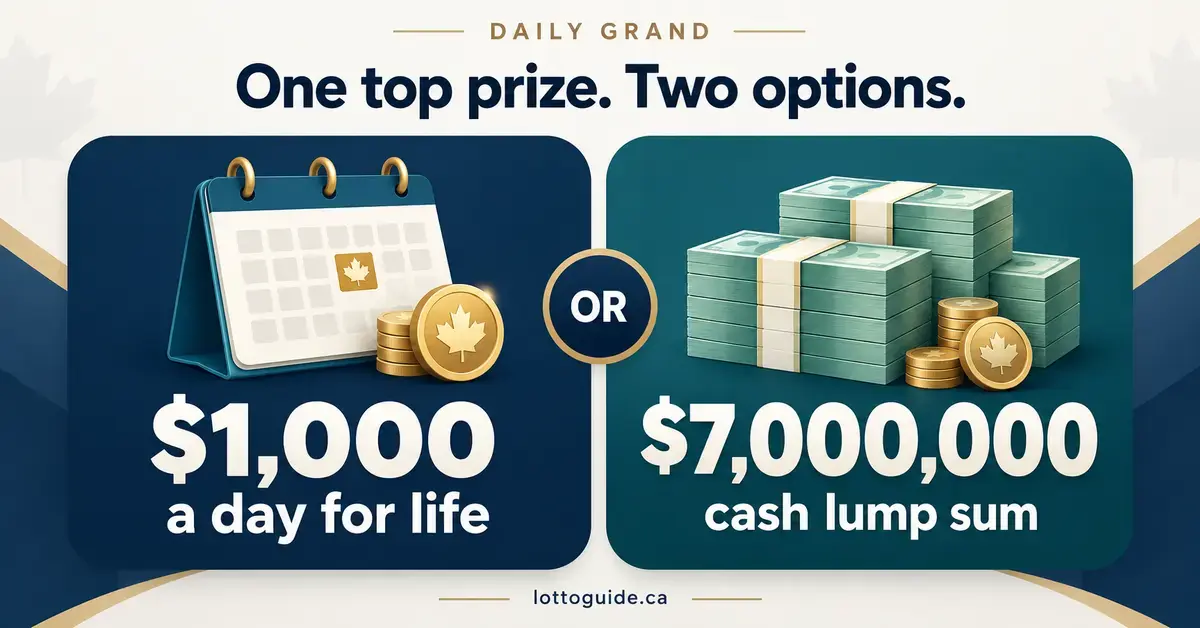
Daily Grand’s headline prize is advertised two ways at once: $1,000 a day for life or a one-time $7,000,000 cash lump sum. Both numbers describe the same win — the grand prize for matching all five main numbers plus the Grand Number — and whoever holds the winning ticket gets to choose between them. This guide explains, factually, how that choice works, how the second prize ($25,000 a year for life or $500,000 cash) compares, what the “for life” promise actually guarantees, and how Canadian tax treatment fits in. It is general information, not financial advice.
If you are new to the game and want the wider picture of how Canada’s national draws fit together, start with our Canadian lottery guide, then come back here for the top-prize detail.
Key Facts
| Game | Daily Grand (national Canadian draw) |
|---|---|
| Top prize | $1,000 a day for life, or $7,000,000 cash |
| How to win it | Match 5 main numbers (1–49) + the Grand Number (1–7) |
| Second prize | $25,000 a year for life, or $500,000 cash |
| Annuity guarantee | Paid for life, with a 20-year guaranteed minimum |
| Cost per play | $3 |
| Draw days | Mondays and Thursdays |
| Grand prize odds | Approx. 1 in 13,348,188 per play |
| Second prize odds | Approx. 1 in 2,224,698 per play |
| Any prize odds | Approx. 1 in 6.8 |
What is the Daily Grand top prize?
The Daily Grand top prize is $1,000 a day for life, or a single cash payment of $7,000,000. You win it by matching all five main numbers (drawn from 1 to 49) plus the single Grand Number (drawn from 1 to 7) in the same draw. A standard play costs $3, and draws are held every Monday and Thursday.
The odds of winning that top prize are approximately 1 in 13,348,188 per $3 play. Because the prize is a fixed, non-progressive amount rather than a growing jackpot, every top-prize winner is offered the same two payout structures no matter when they win.
$1,000 a day for life vs the $7,000,000 lump sum: how the choice works
A top-prize winner picks one of two payout structures for the same prize: a lifetime annuity (the “$1,000 a day” option) or a single cash payment of $7,000,000. The decision is made once, after the win is validated, and it is the single most important number question a Daily Grand winner faces. Below is what each side actually delivers.
What does “$1,000 a day for life” actually pay?
“$1,000 a day for life” works out to $365,000 per year for as long as the winner lives. It is an annuity — a stream of scheduled payments funded by the lottery — not a literal daily deposit of $1,000 into your account. The practical effect is a large, predictable annual income that never runs out during the winner’s lifetime and does not depend on how well the money is invested.
Because the amount is fixed, its real-world value is shaped by inflation over the decades: $365,000 buys less in year 30 than in year one. The trade-off is certainty — the payments arrive regardless of markets, spending habits or investment decisions.
What is the cash lump sum worth?
The lump sum is a single payment of $7,000,000, paid once and in full. The winner receives the entire amount up front and is then responsible for managing, investing or spending it. There are no further lottery payments after the lump sum is taken.
It helps to see the two options side by side in plain arithmetic. The annuity pays $365,000 a year; over the guaranteed minimum of 20 years that is about $7,300,000 — already slightly more than the $7,000,000 cash option — and it keeps paying for life beyond those 20 years. The lump sum, by contrast, hands over $7,000,000 immediately, which a winner could in principle invest to generate income that outlasts or exceeds the annuity. Which comes out ahead depends entirely on how long the winner lives and what return (if any) the cash earns — unknowns that no article can resolve for an individual.
How and when do you choose?
The choice between the annuity and the lump sum is made at the time the prize is claimed and validated, not at the moment of the draw. Winners come forward, present the ticket to the relevant lottery corporation, complete the claim and prize-validation process, and declare their preferred payout option then. Exact claim deadlines and the window for electing annuity versus cash are set out in the official Daily Grand game conditions for your province, so a winner should read those conditions (or ask the lottery corporation) before deciding — the decision is generally final once made.
The second prize: $25,000 a year for life or $500,000 cash
Daily Grand’s second prize is $25,000 a year for life, or a single cash payment of $500,000, and it is won by matching all five main numbers without the Grand Number. The odds of the second prize are approximately 1 in 2,224,698 per play — far better than the top prize, though still a long shot.
The second prize carries the same annuity-versus-cash decision as the jackpot, on a smaller scale. One tidy piece of arithmetic makes the comparison unusually clear: $25,000 a year multiplied by the 20-year guaranteed minimum equals exactly $500,000 — the same as the cash option. So the second-prize lump sum is precisely 20 years of payments delivered at once. A winner who expects to collect for much longer than 20 years gets more total money from the annuity; a winner who prefers all the money now, or who wants to invest it, may lean toward the $500,000. Several publicly reported Canadian second-prize winners have chosen the $500,000 cash.
What the “for life” annuity actually guarantees
The “for life” annuity carries a guaranteed minimum of 20 years, which protects a winner’s family if the winner dies early. Under the official game conditions, payments continue for the remainder of the winner’s life, but if the winner dies before 20 years of payments have been made, a named beneficiary receives the balance of the 20-year minimum. In other words, the annuity is “life with a 20-year floor,” not a bet that disappears the day the winner passes away.
This is an important and often misunderstood point: the annuity is not worthless if the winner dies soon after claiming. The guaranteed-period structure is also why the headline totals are meaningful — the 20-year floor is the minimum anyone in that tier will receive. Winners should confirm the exact beneficiary rules in their province’s game conditions, since the fine print on what happens to remaining payments is set there.
What happens when more than one ticket wins?
When more than one ticket wins the same top-two prize in a single draw, the cash value is shared among the winners rather than each receiving the full annuity. The official rules provide that for the top two prize tiers the lump-sum value is divided among the winning selections. So if two tickets match for the grand prize, the $7,000,000 cash value is split between them; the same sharing logic applies to the $500,000 second-prize cash value. This is a standard feature of fixed “for life” prizes and is one reason the cash figure matters even to winners who like the idea of lifetime payments.
Are Daily Grand prizes taxed in Canada?
Lottery winnings in Canada are generally not taxed. The Canada Revenue Agency (CRA) treats winnings from games of chance as a “windfall” — an unexpected gain the winner had no enforceable right to and did not earn through work or business — and windfalls are not included in income. That applies to both the lump sum and the lifetime annuity payments from a game like Daily Grand.
There are limits to that tax-free status that winners should understand:
- Income earned on the money is taxable. The prize itself is tax-free, but interest, dividends or capital gains you earn after investing it are ordinary taxable income.
- Payments spread over time can involve a taxable interest component. Where a prize is paid out over many years, tax specialists note the portion that represents interest can be taxable as it is received; the structure of official “for life” prizes can affect this. Confirm the specifics with a professional.
- Cross-border winnings differ. Prizes won in the United States, for example, are generally subject to U.S. tax, because that country taxes lottery winnings as income.
None of this is tax advice. A large win is exactly the situation in which a winner should consult an accountant and the CRA directly before making the annuity-versus-cash decision.
Annuity vs lump sum: how to weigh the trade-off
There is no single “right” answer to annuity versus lump sum — the better option depends on the winner’s age, health, financial discipline, and goals. The point of laying out the facts is to show what each structure does, not to recommend one. The table below summarises the honest trade-offs; the planning itself belongs with a qualified, independent adviser.
Annuity vs Lump Sum
| Feature | $1,000 a day for life (annuity) | $7,000,000 lump sum (cash) |
|---|---|---|
| What you receive | $365,000 a year in scheduled payments | A single $7,000,000 payment, up front |
| Duration | For life, with a 20-year guaranteed minimum | One-time; nothing further after payout |
| 20-year total | About $7,300,000, then keeps paying for life | $7,000,000 (fixed) |
| Investment risk | None — payments are fixed and funded by the lottery | Carried entirely by the winner |
| Inflation | Fixed amount loses buying power over decades | Can be invested to try to offset inflation |
| Flexibility | Low — a set income stream | High — full control of the money |
| If multiple tickets win | Cash value is shared instead | $7,000,000 split among winners |
| Canadian tax on the prize | Tax-free windfall | Tax-free windfall |
A few neutral observations that follow from the numbers: the annuity removes investment risk and the risk of spending the money too fast, but locks in a fixed amount that inflation erodes. The lump sum offers maximum flexibility and the chance to grow the money, but places the entire burden of managing $7,000,000 (and the risk of mismanaging it) on the winner from day one.
Common mistakes and misconceptions
The most common mistakes around the Daily Grand top prize are misunderstanding what the prize is, not how to spend it. Watch for these:
- Thinking “$1,000 a day” is paid literally every day. It is an annuity equal to $365,000 a year, scheduled by the lottery — not a daily cash drop.
- Assuming the annuity “dies” with the winner. The 20-year guaranteed minimum means a named beneficiary receives the balance of those 20 years if the winner passes early.
- Treating the lump sum and annuity as obviously equal. They are only equal under specific assumptions about lifespan and investment return; over a long life the annuity can pay far more, while invested cash can outperform it.
- Believing “systems” or buying more tickets meaningfully changes the top-prize odds. At roughly 1 in 13.3 million per play, the grand prize is a rare outcome; no pattern, dream number or strategy improves the per-ticket odds.
- Forgetting the shared-prize rule. If multiple tickets win the top tier in one draw, the cash value is split — so the real amount a winner receives can be lower than the headline figure.
- Rushing the payout decision. The annuity-versus-cash election is generally final; reading the game conditions and getting independent advice first is prudent.
Who the options suit — broadly, the annuity tends to appeal to winners who value guaranteed, hands-off lifetime income and want protection from their own or the market’s mistakes; the lump sum tends to appeal to winners who are confident managing a large sum, have clear investment or debt-repayment plans, or are older and weighing the 20-year floor against life expectancy. Neither is “better” in the abstract.
Disclaimer
Responsible play and compliance note. Daily Grand is a game of chance, not an income strategy. The grand prize is won at odds of roughly 1 in 13.3 million per play, and no system, set of numbers or amount of spending improves those per-ticket odds. Play only with money you can afford to lose, and only if you meet the minimum age in your province (18 or 19 depending on where you live).
This article is general information about how the prize is structured — it is not financial, tax or legal advice. A major win is a situation to discuss with an independent, qualified accountant or financial adviser and with the Canada Revenue Agency before choosing a payout option.
If gambling is causing harm to you or someone you know, free and confidential help is available across Canada. Contact the Responsible Gambling Council or, in Ontario, ConnexOntario (1-866-531-2600); other provinces operate equivalent free support lines.
Sources
Frequently Asked Questions (FAQ)
Is the Daily Grand top prize $1,000 a day or $7 million?
It is one prize offered as two payout options: the winner chooses either $1,000 a day for life (an annuity of $365,000 a year) or a single cash payment of $7,000,000. Only one option is taken per win.
How much is the Daily Grand second prize?
The second prize is $25,000 a year for life, or a $500,000 cash lump sum, won by matching all five main numbers without the Grand Number. The $500,000 equals exactly 20 years of the annual payments.
What happens to the annuity if the winner dies?
The annuity has a guaranteed minimum of 20 years. If the winner dies before 20 years of payments are made, a named beneficiary receives the remainder of that 20-year balance under the official game conditions.
Are Daily Grand winnings taxed in Canada?
No. The CRA treats Canadian lottery winnings as a non-taxable windfall, so both the lump sum and the lifetime payments are tax-free. However, any income you later earn by investing the money is taxable.
Can you change your mind after choosing the lump sum or annuity?
Generally no. The annuity-versus-cash election is made when the prize is claimed and validated and is typically final, which is why winners should read the game conditions and seek independent advice before deciding.
