

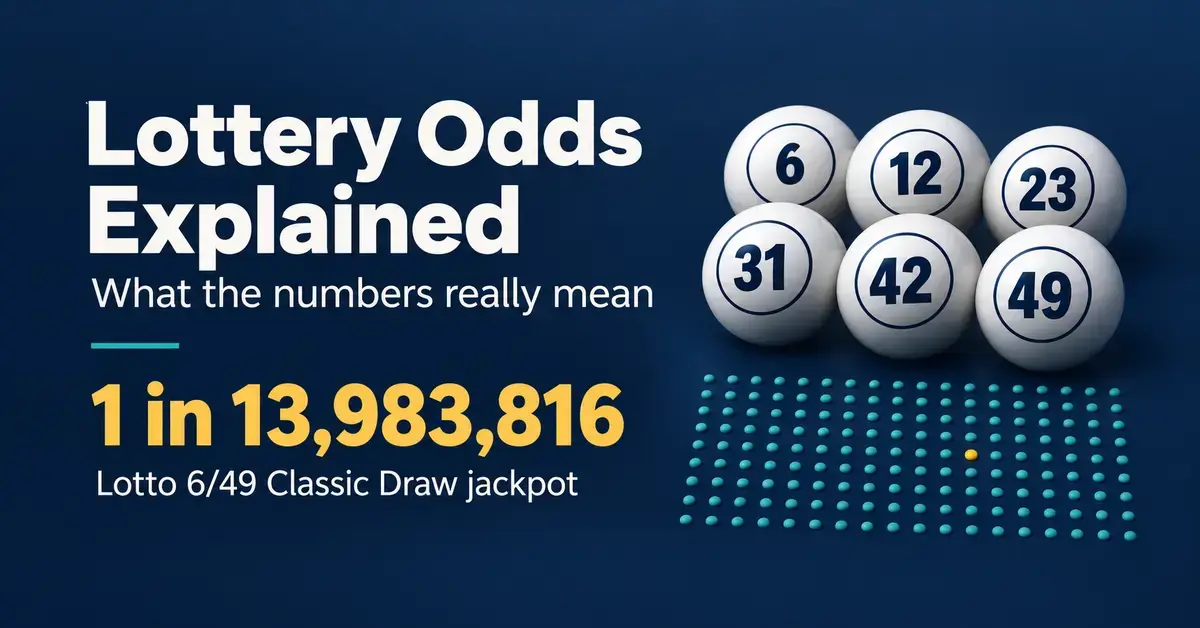
Lottery odds are simply a measure of how likely a given outcome is, written as “1 in X” — so the Lotto 6/49 jackpot at 1 in 13,983,816 means there are almost 14 million equally likely combinations and only one of them wins. This guide explains, in plain English, where that number comes from, the difference between jackpot odds and “overall” odds, and why the expected value of a lottery ticket is always negative. There is no strategy here that improves your chances, because a fair random draw cannot be beaten — only understood. For the bigger picture on Canada’s games, see our Canadian lottery guide.
Key Points
- Lotto 6/49 jackpot odds: match 6 of 49 = 1 in 13,983,816 per line (the fixed $5 million Classic Draw).
- Where the number comes from: “49 choose 6” = 13,983,816 possible combinations, and exactly one wins.
- Overall odds ≠ jackpot odds: overall odds (about 1 in 6.6 for 6/49) count any prize, and most of those are small or a free play.
- Expected value is always negative: on average a ticket returns less than it costs — the fixed $5M jackpot is worth only about 36 cents of a $3 line.
- No strategy beats a fair draw: “due” numbers, hot/cold patterns and systems do not change the odds; each draw is independent and random.
What do lottery odds actually mean?
Odds tell you how many equally likely outcomes exist for every one that counts as a win. When a lottery says the jackpot odds are “1 in 13,983,816,” it means that if you bought one ticket, you would expect to match all the numbers once for every 13,983,816 attempts on average — not that it happens on a fixed schedule.
Two points trip people up. First, a bigger second number means longer odds and a smaller chance: 1 in 34 million is far less likely than 1 in 14 million. Second, each draw is independent. The balls have no memory, so a number that came up last week is exactly as likely to appear this week as any other. Past results never change future odds.
How are lottery odds calculated?
Lottery odds are calculated with combinatorics — the branch of math that counts how many ways you can choose a group of items when the order does not matter. For a game like Lotto 6/49, winning the jackpot means your six chosen numbers match the six drawn, in any order, so the odds are simply one divided by the total number of possible six-number combinations.
Why the order of the numbers does not matter
On a lottery ticket, the balls 4-11-27 win whether they are drawn as 27-4-11 or any other sequence. Counting every ordering separately would inflate the total, so mathematicians use combinations (order ignored) rather than permutations (order counted). Removing the duplicate orderings is the whole trick behind the odds figure.
Working through Lotto 6/49: why it is 1 in 13,983,816
Lotto 6/49’s Classic Draw asks you to pick 6 numbers from 1 to 49. Here is the calculation step by step:
- The first ball can be any of 49 numbers, the second any of the 48 left, and so on down to the sixth. Multiplying gives 49 × 48 × 47 × 46 × 45 × 44 = 10,068,347,520 ordered sequences.
- But order does not matter, and any set of 6 numbers can be arranged in 6 × 5 × 4 × 3 × 2 × 1 = 720 different orders.
- Divide to remove the duplicates: 10,068,347,520 ÷ 720 = 13,983,816.
That is why mathematicians write it as “49 choose 6.” There are 13,983,816 possible combinations and exactly one of them wins the jackpot, so your odds with a single line are 1 in 13,983,816. Buying a second, different line makes it 2 in 13,983,816 — better, but still roughly 1 in 7 million.
What changes when there is a bonus or extra number?
Extra pools multiply the total. Two of Canada’s national games show how:
- Daily Grand asks for 5 numbers from 1 to 49 plus one “Grand Number” from 1 to 7. The five main numbers give “49 choose 5” = 1,906,884 combinations, and the separate Grand Number multiplies that by 7, for top-prize odds of 1 in 13,348,188.
- Lotto Max (reformatted on 14 April 2026) asks for 7 numbers from 1 to 52. One line is “52 choose 7” = 133,784,560, but each $6 play buys four lines, so the jackpot odds work out to roughly 1 in 33,446,140 per play.
The pattern is always the same: count the combinations, and the jackpot odds are one divided by that count (adjusted for how many lines a single purchase covers).
What does “overall odds” mean?
“Overall odds” describe your chance of winning any prize in the game, not the jackpot. Because lotteries pay out small prizes for matching just two or three numbers — and sometimes a free play — the overall odds look far friendlier than the jackpot odds. Lotto 6/49’s overall odds are about 1 in 6.6, Lotto Max’s are about 1 in 5.8, and Daily Grand’s are about 1 in 6.8.
Read those numbers carefully. “1 in 6.6” does not mean a meaningful payout every few tickets. The vast majority of these wins are the smallest tier — often a free play or a return of a few dollars, frequently less than the price of the ticket. Overall odds measure how often you win something, not whether you come out ahead.
The odds of winning the lottery in Canada, side by side
The table below compares Canada’s three national draw games on price, what you pick, the jackpot odds and the overall odds. It makes the gap between “winning anything” and “winning the jackpot” obvious.
Odds Comparison
| Game | Price per play | You pick | Jackpot odds (per play) | Overall odds (any prize) |
|---|---|---|---|---|
| Lotto 6/49 (Classic Draw) | $3 | 6 numbers from 1–49 | 1 in 13,983,816 | approx. 1 in 6.6 |
| Lotto Max | $6 (4 lines) | 7 numbers from 1–52 | approx. 1 in 33,446,140 | approx. 1 in 5.8 |
| Daily Grand | $3 | 5 from 1–49 + 1 Grand Number from 1–7 | 1 in 13,348,188 | approx. 1 in 6.8 |
The headline is the size of the jackpot odds. Matching all six in Lotto 6/49 is about as likely as flipping a coin and getting heads roughly 24 times in a row. For Lotto Max it is rarer still. Those figures do not change no matter which numbers you pick or how long it has been since someone won.
What is expected value — and why is it always negative?
Expected value is the average amount a ticket returns if you could play it over and over: you multiply each prize by its probability, add up the results, and compare the total to what you paid. For every mainstream lottery, that total comes out below the ticket price, which is what “negative expected value” means — on average you get back less than you put in. This is by design, because operators return only part of ticket sales as prizes and direct the rest to provincial governments, retailers and running the games.
A simple expected-value example
Take a $3 Lotto 6/49 line and look only at the fixed $5 million Classic jackpot. Your chance of hitting it is 1 in 13,983,816, so the jackpot’s contribution to the ticket’s value is:
- $5,000,000 ÷ 13,983,816 ≈ $0.36.
In other words, the top prize is worth about 36 cents of the $3 you paid. The lower prize tiers add a little more value, but even after counting every tier the expected return stays well under $3. You are, on average, handing over more than the ticket gives back — every single time.
Why bigger jackpots do not fix the math
For the jackpot alone to “pay for” a $3 ticket, it would need to reach about $42 million (3 × 13,983,816). Some growing jackpots do climb past that break-even point, but expected value usually stays negative anyway for two reasons. First, a huge jackpot draws more players, raising the chance that two or more tickets split the prize. Second, in some countries prizes are taxed. In Canada, lottery winnings are treated as a tax-free windfall by the Canada Revenue Agency, so tax is not the problem here — but prize-splitting and the operator’s built-in cut keep the average return below the price you pay.
Common mistakes people make about lottery odds
Misunderstanding the numbers leads to predictable errors. The most common ones:
- Confusing overall odds with jackpot odds. “1 in 6.6” is the chance of any prize, mostly tiny ones; the jackpot is millions to one.
- Believing numbers are “due.” Each draw is independent, so a number that has not appeared for months is not more likely to come up next.
- Thinking hot or cold numbers matter. Every combination is equally likely in a fair draw; past frequency carries no predictive power.
- Assuming rare-looking picks change the odds. Choosing 1-2-3-4-5-6 has exactly the same chance as any other line. It only changes how many people you might share a prize with, not your probability of winning.
- Expecting a “system” to beat the draw. Wheeling, patterns and number-selection software cannot improve the odds of a random draw; they only change which combinations you cover.
- Overrating extra tickets. Ten lines really do make it 10 in 13,983,816 — but that is still only about 1 in 1.4 million.
Putting the odds in perspective
Understanding lottery odds is useful for anyone who buys the occasional ticket and wants a clear, honest picture of what they are paying for. The numbers are not a reason to play or to avoid playing — they are just the facts: the jackpot is extraordinarily unlikely, most wins are small, and the average ticket returns less than its price. Treated as entertainment with a known cost, a lottery ticket is harmless; treated as an investment or an income plan, the math is firmly against it.
Responsible play
This article is for information only. It is not betting advice, and nothing here improves your chance of winning. Lotteries in Canada are games of chance with a negative expected value, which means players lose money on average over time. You must be of legal age in your province or territory to buy tickets. Play only with money you can afford to lose, set your own limits, and never try to win back losses by spending more. If gambling is causing harm to you or someone you know, free, confidential help is available — in Ontario through ConnexOntario (1-866-531-2600), and nationwide through the Responsible Gambling Council; every province also operates its own problem-gambling helpline.
Sources
- OLG — The new Lotto Max is here (format, price and odds, April 2026)
- BCLC — The new Lotto Max is here
- Global News — Lotto Max odds explained
- Global News — Lotto 6/49 Gold Ball Draw and jackpot format
- CTV News — $5 million Lotto 6/49 Classic jackpot won in Scarborough
- Western Canada Lottery Corporation — Lotto Max FAQ
- CNW/Newswire — Daily Grand launch release (rules and top prize)
- CTV News — How lottery winnings are taxed for Canadians
Frequently Asked Questions (FAQ)
What are the odds of winning the Lotto 6/49 jackpot?
The odds of matching all six numbers in the Lotto 6/49 Classic Draw are 1 in 13,983,816 for a single line. That is the number of possible six-number combinations from 1 to 49, and only one of them wins the fixed $5 million Classic jackpot.
How are lottery odds calculated?
They are calculated by counting how many combinations of numbers are possible, using combinatorics where the order of the numbers does not matter. For 6/49 you multiply 49 × 48 × 47 × 46 × 45 × 44 and divide by 720 (the number of ways six numbers can be ordered), which gives 13,983,816. Your jackpot odds are one divided by that total.
What is the difference between jackpot odds and overall odds?
Jackpot odds are your chance of winning the top prize; overall odds are your chance of winning any prize at all, including the smallest tiers. Overall odds look much better — around 1 in 6 to 1 in 7 for Canada’s national games — but most of those wins are small amounts or free plays, not the jackpot.
Is the expected value of a lottery ticket ever positive?
Almost never. Expected value is the average return per ticket, and for mainstream lotteries it is always below the ticket price because operators keep part of every sale. Even when a jackpot grows past the mathematical break-even point, prize-splitting among multiple winners usually pushes the expected value back into negative territory.
Does buying more tickets improve my odds?
Yes, but only in direct proportion, and the chance stays tiny. Two different lines double your jackpot chance to 2 in 13,983,816, and ten lines make it 10 in 13,983,816 — still only about 1 in 1.4 million. No amount of buying, and no number-picking system, changes the odds of each individual line.
