

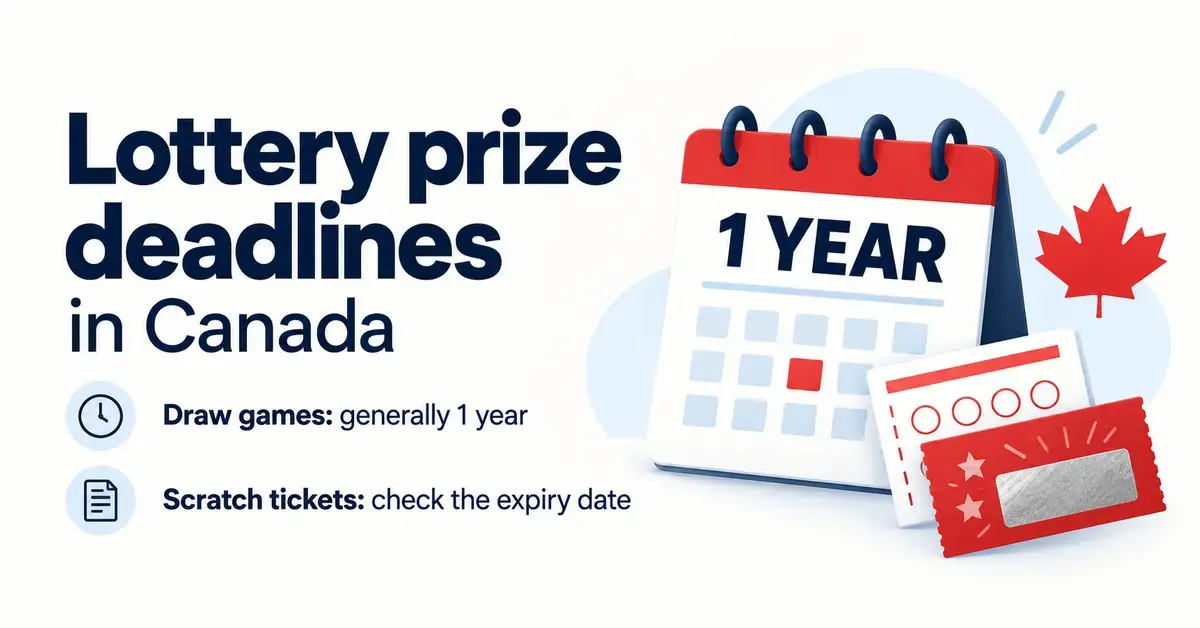
In Canada you generally have one year from the draw date to claim a prize on a draw-based lottery game such as Lotto 6/49, Lotto Max or Daily Grand. Scratch (instant) tickets work differently: each one carries its own expiry date printed on the ticket. Miss the deadline and the prize is gone for good, with the money returned to players through future draws rather than kept by the lottery. Because Canada has no single national lottery operator, the fine print varies a little by province, so this guide sets out the rules clearly and shows where to check for your own ticket.
Key Facts
- Draw games (Lotto 6/49, Lotto Max, Daily Grand): one year (52 weeks) from the draw date.
- Scratch / instant tickets: expire on the date printed on the ticket (often longer than a year).
- Clock starts: on the draw date shown on the ticket, not the purchase date.
- Add-ons (Encore, Extra): follow the same one-year rule tied to the draw date.
- Miss the deadline: the ticket is voided and the money is recycled to players via future draws.
- How to protect a win: sign the ticket, check numbers early, and diarise the one-year deadline.
How long do you have to claim a lottery prize in Canada?
For the national draw games, you have one year (52 weeks) from the draw date to come forward. This single rule covers Lotto 6/49, Lotto Max and Daily Grand no matter which province you bought the ticket in, because all three are national games administered on a shared basis and then paid out by your regional lottery corporation.
The one-year window is a hard deadline, not a guideline. Lottery corporations have to balance their prize accounts and cannot hold money aside indefinitely, so once the anniversary of the draw passes, a winning ticket is declared void. Smaller provincial and regional games follow the same one-year standard unless the ticket or the corporation states otherwise.
If you want the bigger picture on the games themselves before you check a deadline, our overview of how Canada’s national lotteries work explains the draws, odds and prize tiers.
Draw date, not purchase date — the nuance that trips people up
The clock starts on the draw date printed on your ticket, not the day you bought it. This is the single most common misunderstanding about lottery deadlines in Canada, and it almost always works in the ticket holder’s favour.
Say you buy a Lotto Max ticket three days before the draw. Your one-year claim window does not begin when you pay the retailer; it begins on the draw date itself. So the practical deadline is one year after the numbers were drawn, giving you slightly more time than the purchase date would suggest. For multi-draw or advance-play tickets that cover several draws, each draw has its own date, and the claim deadline for any winning line is measured from that specific draw date.
Two points follow from this:
- Check the draw date on the ticket, then count one year forward to find your deadline.
- Keep advance-play tickets until the last draw on them has passed and you have confirmed the results for every draw date listed.
Claim deadlines for the national draw games (6/49, Lotto Max, Daily Grand)
All three national games share the one-year-from-draw-date rule. The table further down breaks the deadlines out by corporation, but the headline figures are simple:
- Lotto 6/49 — one year from the draw date.
- Lotto Max — one year from the draw date (this also covers the MaxMillions lines drawn alongside large jackpots).
- Daily Grand — one year from the draw date, including the annuity-style top prize.
Add-on games bought with your main ticket, such as Encore or Extra, follow the one-year rule tied to the same draw date. Where a prize is paid as an annuity (for example Daily Grand’s “grand” prize), the one-year deadline applies to coming forward and starting the claim — not to collecting every future payment.
Scratch and instant tickets have their own printed expiry
Scratch tickets do not follow the one-year draw rule because there is no draw. Instead, each instant game is assigned an expiry date that is printed on the ticket or published by the lottery corporation, and that date is what counts. Instant tickets are manufactured and distributed months in advance, so their claim windows are usually longer than a single year — in Ontario, for example, instant-game prizes typically remain claimable for roughly one and a half to two years.
The safe habit is the same for every scratch ticket: read the back of the ticket, note the printed expiry, and do not assume it matches the one-year draw-game rule. If the expiry is not obvious, the lottery corporation’s instant-games page or support line can confirm it.
Claim deadlines by province and lottery corporation
Canada’s lotteries are run by five regional corporations rather than one national body, and each one pays out prizes for players in its territory. The national games carry the same one-year deadline everywhere, but the exact wording and the instant-ticket rules differ slightly. Use the table to find the corporation that covers where you bought your ticket.
Claim Deadlines by Lottery Corporation
| Lottery corporation | Region covered | Draw-game claim period | Scratch / instant tickets | Player care line |
|---|---|---|---|---|
| OLG | Ontario | 1 year from the draw date | Printed expiry (instants typically ~1.5–2 years) | 1-800-387-0098 |
| Loto-Québec | Quebec | 365 days from the draw date | Printed expiry on the ticket | Via lotoquebec.com |
| Atlantic Lottery (ALC) | New Brunswick, Nova Scotia, PEI, Newfoundland & Labrador | 1 year from the draw date | Scratch’N Win printed expiry | 1-800-561-3942 |
| WCLC | Alberta, Saskatchewan, Manitoba & the territories | 1 year (52 weeks) from the draw date | Zing / instant printed expiry | 1-800-665-3313 |
| BCLC | British Columbia | 52 weeks from the printed draw date | Scratch & Win printed expiry | Via bclc.com |
National games (Lotto 6/49, Lotto Max, Daily Grand) carry the one-year deadline in every region; claim from the corporation that serves where the ticket was bought.
Whichever corporation applies, the governing detail is always the same: the draw date printed on the ticket sets the deadline, and the claim must be started on or before that anniversary date to be valid.
What happens to unclaimed lottery prizes in Canada?
Unclaimed money does not stay with the lottery corporation — it goes back to players. When a prize on a national game (Lotto 6/49, Lotto Max, Daily Grand) is not claimed within the one-year window, the money is returned to the prize structure and recycled through future guaranteed jackpots, bonus draws and promotional prizes. For regional and provincial games, unclaimed amounts are generally returned to the member provinces and territories as revenue.
Unclaimed prizes are rarer than the headlines suggest. OLG has estimated that only about 1% of all prizes go unclaimed, and the large majority of those are small amounts of a few dollars. It is unusual for a major prize to expire, which is exactly why a six- or seven-figure unclaimed ticket makes the news as its deadline approaches. Each corporation publishes a list of unclaimed prizes (often for amounts of $10,000 and up) on its website so players can check whether a prize from their area is still open.
How to make sure you don’t miss the deadline
The best protection is to check and secure your ticket early rather than relying on the full year. A few simple habits prevent nearly every missed-deadline story.
- Sign the back of the ticket immediately. A signed ticket is far easier to claim and much harder for someone else to cash if it is lost.
- Check your numbers promptly using the lottery app, the corporation’s website or a retailer’s ticket checker, instead of leaving tickets in a drawer.
- Diarise the deadline for any winning ticket by counting one year from the draw date.
- Start big claims by phone or appointment well before the deadline, because larger prizes require verification that takes time to arrange.
Common mistakes that cost people their prize
- Assuming the clock runs from the purchase date — it runs from the draw date, which is sometimes later.
- Treating a scratch ticket like a draw ticket — scratch tickets use the printed expiry, which can be shorter or longer than a year.
- Forgetting advance-play and subscription draws — each draw on the ticket has its own deadline.
- Throwing away “non-winning” tickets without a proper check — free-play and small secondary prizes are easy to overlook.
- Leaving a large claim to the final days — if the appointment or paperwork slips past the anniversary date, the claim can be refused.
What if you have already missed the deadline?
Once the one-year window closes, the lottery is normally under no obligation to pay, and the prize is declared void. Corporations such as OLG have said they may still review a late claim on a case-by-case basis if someone comes forward shortly after the deadline with a legitimate reason, but this is discretionary and should never be relied on. The only dependable approach is to claim within the deadline.
If you think you hold a winning ticket but cannot find it, contact the relevant corporation’s customer care line as soon as possible and be ready to provide details such as where and when the ticket was bought. Acting quickly gives any investigation the best chance while the claim period is still open.
Friskrivning
This article is for general information only and is not official lottery advice. lottoguide.ca is an independent, unofficial guide and is not affiliated with OLG, BCLC, WCLC, Loto-Quebec, the Atlantic Lottery Corporation or any lottery operator. Claim rules, deadlines and contact details can change, so always confirm the deadline for your specific ticket with the relevant lottery corporation or the fine print printed on the ticket. Lottery games are a form of gambling and are available only to players who meet the minimum age in their province (18 or 19). Play within your means; if gambling is causing you harm, free confidential help is available through your provincial responsible-gambling service.
Sources
- OLG — lottery prize claims and unclaimed-prize information (Ontario)
- Western Canada Lottery Corporation (WCLC) — claiming a prize and unclaimed prizes
- BCLC — winning and claiming (British Columbia, 52-week rule)
- Loto-Québec — collect a prize (365-day window)
- Atlantic Lottery Corporation (ALC) — customer support and claims
- CTV News — WCLC on one-year draw-game claim periods
- Global News — unclaimed Lotto Max ticket and the one-year deadline
Vanliga frågor (FAQ)
How long do you have to claim a lottery prize in Canada?
For draw games such as Lotto 6/49, Lotto Max and Daily Grand, you have one year (52 weeks) from the draw date. Scratch tickets instead expire on the date printed on the ticket, which is usually different from one year.
Does the claim deadline start from the purchase date or the draw date?
From the draw date printed on the ticket, not the day you bought it. If you buy a ticket a few days before the draw, your one-year window still begins on the draw date, giving you slightly more time than the purchase date would suggest.
What happens to lottery prizes that are never claimed?
The money goes back to players. For the national games it is recycled into future guaranteed jackpots, bonus draws and promotions; for regional games it is returned to the member provinces. The lottery corporation does not keep expired prize money.
Do scratch tickets expire at the same time as draw games?
No. Scratch (instant) tickets carry their own printed expiry date because there is no draw to count from. These windows are often longer than a year, but you must check the date on each ticket rather than assume the one-year rule applies.
Can you still claim a prize after the deadline has passed?
Usually not. Once the window closes the ticket is normally void. Some corporations say they may review a late claim case by case if you come forward soon after with a genuine reason, but this is discretionary and should never be counted on — claim within the deadline.
