

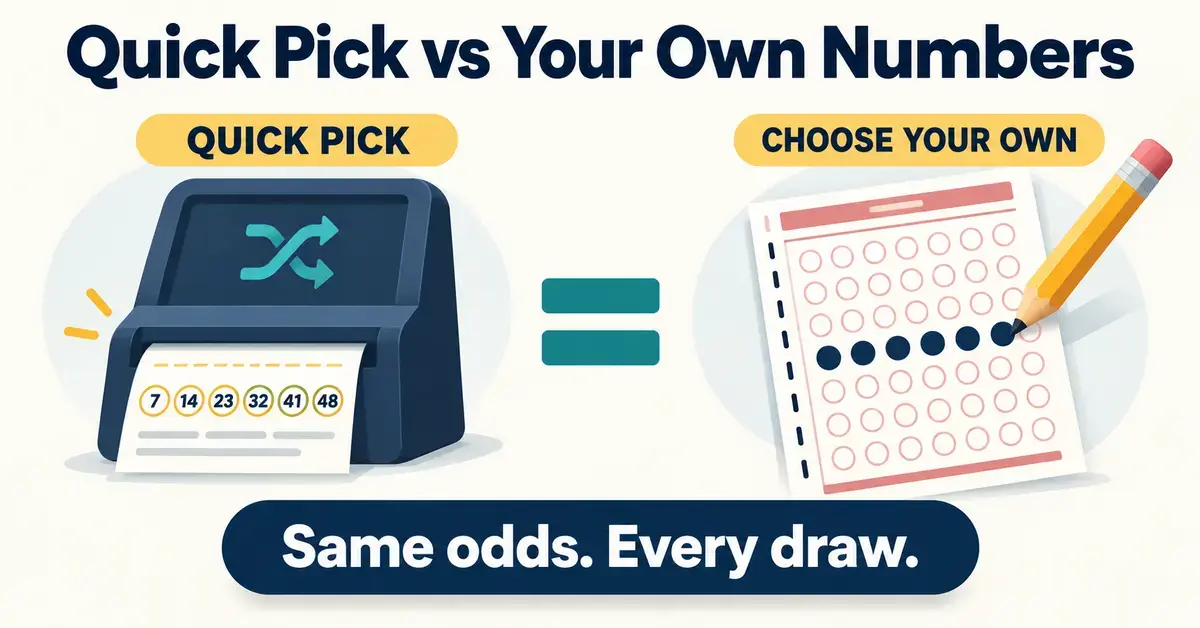
When you buy a Lotto 6/49, Lotto Max or Daily Grand ticket in Canada, you face one small decision: let the terminal pick your numbers for you (a Quick Pick) or choose your own. A lot of players believe one method wins more often than the other. It does not. A Quick Pick and a set of numbers you choose yourself have exactly the same chance of winning, because the draw itself is random. This guide explains how each option works, why their odds are identical, and which lottery “strategies,” “systems” and lucky-number beliefs are myths — using the real numbers behind Canada’s national games.
Key Takeaways
- A Quick Pick and numbers you choose yourself have exactly the same odds of winning — the draw is random.
- Lotto 6/49 jackpot odds are 1 in 13,983,816; Lotto Max jackpot odds are 1 in 33,294,800 per $5 play, no matter how you pick.
- There are no “hot,” “cold” or “overdue” numbers — every draw is independent of the last.
- No app, software or “system” can predict a certified random draw.
- Your number choice can affect how many people you’d share a jackpot with, not whether you win.
What is a Quick Pick?
A Quick Pick is a ticket where the lottery terminal chooses your numbers randomly instead of you filling in a selection slip. In Canada you simply ask the retailer for a Quick Pick (some provinces and the OLG and BCLC apps call the same thing an “easy pick” or “computer pick”), and the terminal generates a valid set of numbers for the game you are playing. For Lotto 6/49 that is six numbers from 1 to 49; for Lotto Max it is seven numbers from 1 to 50.
The appeal of a Quick Pick is speed and convenience. You do not have to decide anything, you cannot accidentally mark an invalid line, and the numbers are spread across the full range at random. The trade-off is that you have no control over the combination and you cannot easily play the same numbers every draw unless you keep the ticket details.
What does choosing your own numbers mean?
Choosing your own numbers means you fill in a selection slip (or tap your numbers into the app) so that your ticket carries a specific combination you picked. Players do this for all sorts of reasons: birthdays, anniversaries, house numbers, “lucky” figures, or a set they have played for years and do not want to miss.
Self-picking gives you two practical things a Quick Pick does not: the ability to play the exact same numbers consistently, and a personal connection to the ticket. What it does not give you is any mathematical edge. The lottery terminal does not treat a hand-picked line differently from a randomly generated one — to the draw, every valid combination is just one of millions.
Do Quick Picks have better odds than your own numbers?
No. The odds of winning are identical whether the terminal picks your numbers or you do. This is the single most important fact in this whole topic. A lottery draw selects a combination at random, so every possible combination has the same probability of being drawn — including your birthday numbers, a “random” Quick Pick, and the most obvious sequence you can think of.
The odds are fixed by the game’s design, not by how you choose. Here are the real jackpot odds for Canada’s national games:
| Game | You match | Jackpot odds (per play) | Price |
|---|---|---|---|
| Lotto 6/49 | 6 of 6 numbers (1–49) | 1 in 13,983,816 | $3 |
| Lotto Max | 7 of 7 numbers (1–50) | 1 in 33,294,800 (per $5 play) | $5 for 3 selections |
Those numbers do not move one inch based on your selection method. A Quick Pick of 3-11-19-27-35-42 and a hand-picked 1-2-3-4-5-6 both have a 1 in 13,983,816 chance of being the Lotto 6/49 jackpot combination. If you want to see how these probabilities are built from the size of the number pool, our Canadian lottery guide walks through how each national game is structured.
Quick Pick vs Your Own Numbers
| Factor | Quick Pick | Choosing your own |
|---|---|---|
| Odds of winning | Identical | Identical |
| Speed to buy | Fastest — no slip to fill | Slower — you mark each number |
| Play the same set each draw | Harder | Easy |
| Numbers spread across full range | Yes, automatically | Only if you choose them that way |
| Personal/meaningful numbers | No | Yes |
| Risk of sharing a jackpot | Lower (random spread) | Higher if you use dates/patterns |
| Cost | Same as self-pick | Same as Quick Pick |
Why do more winners seem to use Quick Picks?
More jackpots are won on Quick Pick tickets mainly because more tickets are sold as Quick Picks. In large lotteries, a big majority of players use the auto-pick option, so a similar majority of winning tickets are Quick Picks. That is a reflection of how people buy tickets, not evidence that the method is luckier.
Think of it this way: if 75% of all tickets are Quick Picks, you would expect roughly 75% of winners to be Quick Pick players, purely by proportion. The reverse is also true — in a lottery where most players hand-pick, most winners would be hand-pickers. Either way, the win rate per ticket is the same. Headlines about “Quick Pick winners” are counting popularity, not an advantage.
Lottery number myths, debunked
Most number-picking “strategies” are built on a misunderstanding of how random draws work. Here are the common ones and why they do not hold up.
Myth: some numbers are “hot” or “due”
There are no hot, cold or overdue numbers. Each draw is independent, meaning the balls or the random number generator have no memory of previous results. A number that came up last week is exactly as likely to appear as one that has not shown in a year. The belief that an absent number is “due” is a well-known thinking error called the gambler’s fallacy; the belief that a recent winner is “on a streak” is the hot-hand fallacy. Research into lottery betting has documented both patterns in how people choose numbers — but neither changes the odds of the draw.
Myth: avoiding recent numbers improves your chances
Skipping recently drawn numbers does nothing for your odds. Because every draw starts fresh, the next result is just as likely to repeat a recent number as to avoid it. Frequency charts of “most-drawn numbers” describe the past; they have zero predictive power for the next draw. Over enough draws, every number trends toward the same frequency anyway.
Myth: software or a “system” can predict the draw
No app, algorithm, wheel or paid “system” can predict a random lottery draw. Canada’s 6/49 and Lotto Max draws are produced by certified random number generators, which exist specifically to make the outcome unpredictable. Any product that promises to forecast winning numbers, or to “improve your odds,” is selling you a pattern that is not there — and often charging for it. The only thing buying more lines changes is how much you spend. Be especially cautious of paid prediction tools, which cannot deliver what they advertise.
Myth: there are “best” lottery numbers to pick
There is no set of numbers that is more likely to win than any other. The idea of “best lottery numbers to pick” only makes sense in one narrow way, and it is not about winning: it is about not splitting the prize if you do win (more on that below). For your chance of matching the draw, 7-13-28 is neither better nor worse than any other figures.
Does your number choice affect anything at all?
Your choice can affect how much you would win, not whether you win. This is the one genuine, math-backed difference between combinations — and it only matters if your numbers are drawn. If several people play the same winning combination, they split the jackpot equally.
Because many players pick numbers from birthdays and dates, the figures 1 through 31 are chosen far more often than 32 to 49 (or 32 to 50 in Lotto Max). A classic 1998 University of Southampton study of ticket popularity found exactly this skew and concluded that playing less popular numbers could meaningfully reduce the chance of having to share a jackpot. The most famous real-world example came from a 1995 UK draw in which 133 players independently chose the same “pattern” combination and each walked away with a tiny fraction of what a sole winner would have taken.
So if you self-pick, spreading numbers above 31 (and avoiding obvious patterns and sequences) can lower the odds of sharing a prize. A Quick Pick does something similar automatically, since it draws from the full range at random. Neither approach makes you more likely to win — they only influence how crowded your combination is.
Common mistakes players make
The most common mistakes come from treating a random game as if it were predictable. Watch out for these:
- Spending more to “chase” a system. Buying extra lines to follow hot/cold charts or a prediction app increases your cost, not your odds per combination.
- Playing only birthday numbers. This caps your range at 31 and raises the chance of sharing a jackpot with other date-pickers.
- Believing a near-miss means you are “close.” Matching five of six numbers is a separate, independent outcome — it does not mean the jackpot is coming.
- Paying for “guaranteed” or “winning” number services. These cannot work against a certified random draw and are a frequent vehicle for scams.
- Skipping the ticket check or the deadline. Whatever method you use, a winning ticket only pays if you validate it before the claim deadline.
Quick Pick or your own numbers: which should you choose?
Choose whichever you enjoy more, because the result is the same. If you value speed, want numbers spread randomly across the range, and have no attachment to specific figures, a Quick Pick is the simplest option. If you like playing a consistent set, enjoy the ritual of choosing, or want to deliberately pick higher numbers to reduce prize-sharing, self-picking suits you better.
What matters far more than the method is treating the lottery as paid entertainment with a known, fixed cost — not as an investment or a plan. The odds above make clear that no choice of numbers turns a long shot into a likely one.
Responsible Play
Lotteries in Canada are games of chance with very long odds, and this article is informational only — it is not advice to play and does not improve anyone’s chance of winning. No method of choosing numbers, and no app, system or service, can change a random draw. You must be of legal age to play in your province or territory (18 or 19 depending on where you live). Only ever spend what you can comfortably afford to lose, and treat any ticket as entertainment rather than a way to make money.
If gambling is causing stress for you or someone you know, free, confidential help is available 24/7. In Ontario you can reach ConnexOntario at 1-866-531-2600 or by texting CONNEX to 247247; other provinces run their own problem-gambling helplines, and the Responsible Gambling Council offers information and support across Canada.
Sources
- Ontario Lottery and Gaming Corporation (OLG) — Lotto 6/49 & Lotto Max game information
- British Columbia Lottery Corporation (BCLC) — jackpot odds
- CTV News — The new Lotto 6/49: Gold Ball Draws and the Classic Draw
- Global News — Lotto Max odds explained
- NBC/Associated Press — Are the odds better with your own numbers or a Quick Pick?
- University of Southampton — study of lottery number popularity and jackpot sharing
- Management Science — Judgment Error in Lottery Play: the Hot Hand and the Gambler’s Fallacy
- ConnexOntario — free, confidential problem-gambling support
Frequently Asked Questions (FAQ)
Are Quick Picks better than choosing your own numbers?
No. A Quick Pick and a self-chosen combination have identical odds of winning, because the draw is random and every valid combination is equally likely. Any difference between the two is about convenience and prize-sharing, not your chance of winning.
Why do so many winners play Quick Picks?
Because most tickets sold are Quick Picks, so most winning tickets are too. The proportion of Quick Pick winners simply mirrors how many people use the option — it is not evidence that the method wins more per ticket.
Are there hot or cold lottery numbers?
No. Each draw is independent, so past results do not make any number more or less likely to appear next. “Hot,” “cold” and “overdue” numbers are myths based on the gambler’s fallacy; frequency charts describe history, not the future.
Can software or a system predict winning lottery numbers?
No. Canadian lottery draws use certified random number generators specifically so the outcome cannot be predicted. Any app, wheel or paid service claiming to forecast winning numbers cannot deliver that, and some are outright scams.
What are the best lottery numbers to pick?
No numbers are more likely to be drawn than others. The only real benefit of number choice is reducing prize-sharing: picking figures above 31 and avoiding common patterns lowers the odds of splitting a jackpot, but it does not improve your chance of winning.
